
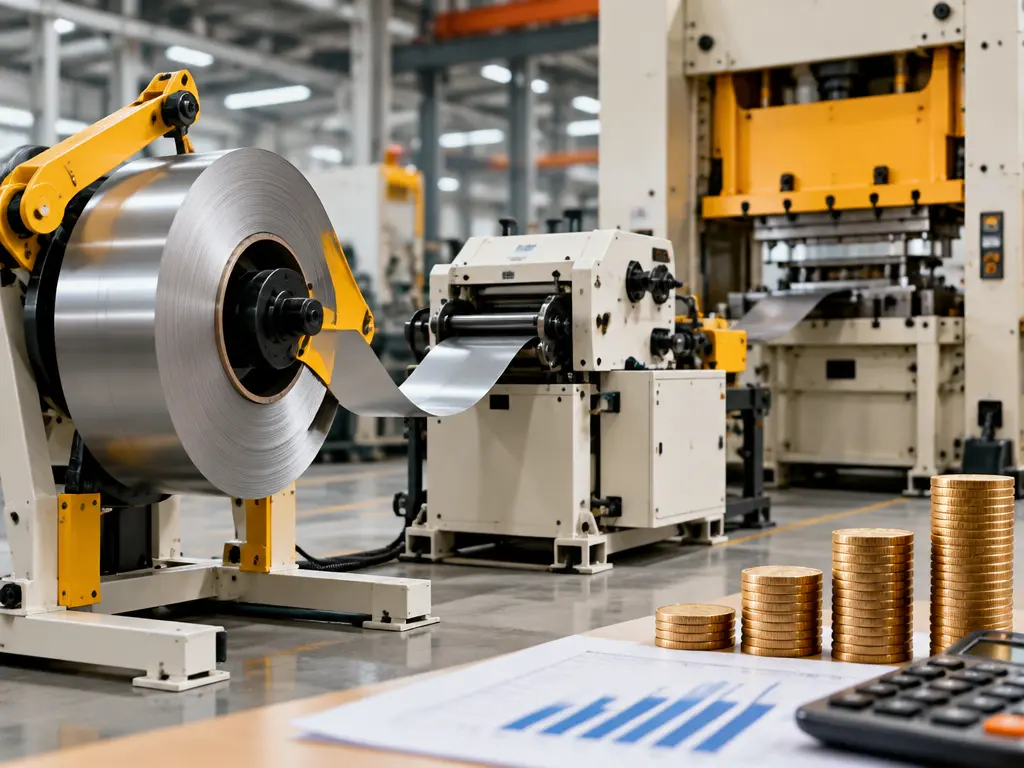
“How much does a coil feeding system cost?” It’s the most common question we get — and the honest answer is: it depends on your material, your press, and what you’re trying to achieve.
A basic pneumatic feeder for a small press might cost a few hundred dollars. In contrast, a complete turnkey stamping automation line with a 3-in-1 unit, handling robot, and coil car can run into six figures. Most stamping shops fall somewhere in between.
Therefore, this guide breaks down the coil feeding system cost factors, price ranges, and what you should budget — so you can make an informed decision, not just chase the lowest quote. For background on the stamping process itself, see Wikipedia’s stamping article.
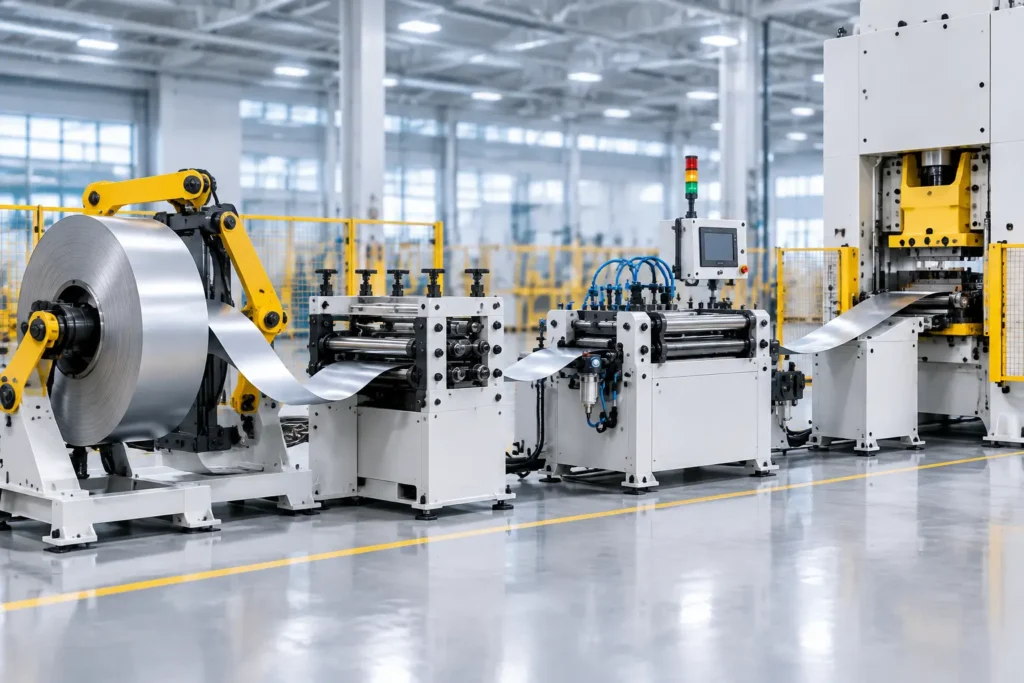
What Drives Coil Feeding System Cost
Seven factors determine the price of your feeding equipment. In fact, understanding these coil feeding system cost drivers is the first step to budgeting correctly:
1. Material Width and Thickness
The biggest cost driver is material width and thickness. A feeder designed for 100mm-wide, 1mm-thick mild steel is a completely different machine from one built for 800mm-wide, 4.5mm-thick stainless steel. Wider material requires larger frames, longer rollers, and more powerful motors. Thicker material, in turn, requires higher clamping force and more rigid construction.
Rule of thumb: Doubling the width can increase the cost by 40–60%. Doubling the thickness capacity can add 30–50%.
2. Feeding Accuracy
Standard accuracy (±0.3mm) is the baseline. By contrast, high-accuracy systems (±0.15mm or better) require premium servo drives (Yaskawa, Mitsubishi), higher-resolution encoders, and tighter roller tolerances — adding 15–25% to the total.
For general stamping, ±0.3mm is sufficient. However, for progressive dies and automotive parts, the extra investment in accuracy pays for itself in reduced scrap.
3. Machine Configuration (Separate vs. 3-in-1)
Configuration is another major driver of the cost. Specifically, it comes down to this trade-off:
- Separate components (decoiler + leveler + feeder): More flexible, easier to service individually, but requires more floor space and costs more in total (three machines)
- 3-in-1 compact unit: 20–30% less total cost than three separate machines, saves floor space, but slightly less flexible for extreme format changes
4. Automation Level
Automation drives both the price and the labor cost. Consider these tiers:
- Manual loading, manual adjustment: Lowest cost, highest labor
- Hydraulic decoiler expansion + motorized leveler gap: Mid-range, reduces changeover time
- Coil car + automatic threading + recipe-based setup: Highest cost, lowest labor, fastest changeovers
5. Coil Weight Capacity
A decoiler rated for 500kg coils costs significantly less than one rated for 10-ton coils. The frame, mandrel, drive motor, and brake system all scale with capacity — and every increase raises the total. As a result, heavier coils demand a more expensive machine.
6. Custom vs. Standard
Standard models (like Jingcui’s NLF1 series) are produced in batches, keeping the coil feeding system cost lower. Custom configurations for unusual material widths, special coatings, or unique press interfaces add engineering and one-off manufacturing costs. Therefore, standard beats custom whenever your requirements fit a catalog model.
7. Export-Ready Features
For international buyers, export-ready features also affect the price: proper wooden crate export packing, English documentation and manuals, CE certification (for EU destinations), and factory testing documentation. These typically add 5–10% to the equipment cost — essential for international transactions, not optional.
Price Ranges by Equipment Type (FOB China, 2026 Estimates)
⚠️ These are indicative ranges that break down the coil feeding system cost by component. Factory-direct pricing from a manufacturer like Jingcui varies with your width, thickness, and configuration. Get a formal quotation for your application.
| Equipment | Typical Price Range (FOB) | What Affects Price |
|---|---|---|
| Pneumatic feeder (basic) | 400–1,500 | Width, cylinder size |
| NC servo feeder (standard) | 3,000–8,000 | Width (100–800mm), motor brand |
| NC servo feeder (wide, heavy) | 8,000–18,000 | Width 800–1300mm, torque requirements |
| Precision leveler (standalone) | 5,000–15,000 | Roll count, width, motorized vs manual |
| Decoiler (light-duty, 500kg) | 1,500–3,000 | Manual vs motorized |
| Decoiler (heavy-duty, 5–10T) | 4,000–12,000 | Hydraulic expansion, drive system |
| 3-in-1 compact unit (400–800mm) | 12,000–30,000 | Width, coil weight, servo brand |
| 3-in-1 compact unit (large, 1000mm+) | 25,000–50,000 | Frame size, motor power, leveling rolls |
| Handling robot (6-axis) | 15,000–35,000 | Payload, reach, brand |
| Complete turnkey line (decoiler + leveler + feeder + robot) | 40,000–100,000+ | Width, automation level, robot inclusion |
Example: Standard Appliance Stamping Line
- NLF1-600 3-in-1 feeder (600mm width, 5000kg coil): ~$18,000
- Export packing + documentation: ~$1,500
- Total FOB: ~$19,500
Example: Heavy Automotive Stamping Line
- Heavy-duty decoiler (8T): ~$8,000
- Precision leveler (800mm, 11-roll): ~$12,000
- NC servo feeder (800mm): ~$10,000
- Export packing + documentation: ~$2,000
- Total FOB: ~$32,000
These are factory-direct prices from a Shunde, Foshan manufacturer. Meanwhile, distributors and trading companies typically add 20–40% markup. Browse our products for the full range.
Hidden Costs That Raise Your Coil Feeding System Cost
The equipment price is not the total cost. In fact, you need to factor in several hidden expenses that push the coil feeding system cost higher:
International Freight (A Hidden Coil Feeding System Cost)
Sea freight from China to Southeast Asia runs 500–1,500 per unit. To the Middle East, count on 1,000–3,000. To Europe or the Americas, expect 2,000–5,000.
Import Duties
Check your country’s tariff rates for HS code 8462 (stamping/punching machines) or related categories. Vietnam and Thailand sit at 0% under ACFTA, whereas India runs about 7.5%, Saudi Arabia and the UAE charge 5%, and the EU applies 2–5%.
Installation and Setup
If you can install in-house, this cost is minimal. Otherwise, if you need the manufacturer’s engineer on-site, budget 2,000–5,000 for travel, accommodation, and daily service rates (varies by destination).
Spare Parts (Part of Your Coil Feeding System Cost)
Budget $500–$1,500 for an initial spare parts kit: a set of feed rollers, leveler roller bearings, seals, and common wear items. Having spares on hand, in turn, eliminates weeks of downtime waiting for international shipping.
Training
Most manufacturers include basic operator training in the equipment price. If you need extended training or training for multiple shifts, confirm this upfront — otherwise it becomes a hidden addition to the total coil feeding system cost.
How to Get the Best Coil Feeding System Cost (Not Just the Lowest Price)
1. Buy Factory-Direct
Every intermediary between you and the manufacturer adds margin. Therefore, buying from a factory like Jingcui means you pay the manufacturing cost plus reasonable margin — not that plus a trading company’s markup. Learn how to spot the difference in our Chinese stamping manufacturer guide.
2. Spec for What You Actually Need
Don’t buy a 1300mm-wide feeder if your widest part is 600mm. Don’t spec a 10-ton decoiler for 3-ton coils. However, don’t spec to the millimeter either — in other words, leave 20–30% headroom on width and thickness so you’re not locked into exactly today’s production.
3. Bundle the Line
If you need a decoiler, leveler, and feeder, buying them as a configured package from one manufacturer is typically 15–25% cheaper than sourcing each from different suppliers. Plus, you get single-source warranty and support — which also lowers your long-term coil feeding system cost.
4. Plan for the Future
A feeder with 600mm capacity costs only 10–15% more than one with 400mm capacity. Consequently, if there’s any chance you’ll run wider material in the next 3–5 years, the upfront premium is far less than replacing equipment later. After all, re-specifying a line is far cheaper than rebuilding one.
Jingcui’s Pricing Philosophy
At Jingcui Automation, we’re a factory-direct manufacturer — not a trading company. That means you deal directly with the people who design, build, and test your equipment. There are no middlemen, no inflated margins, and no “we need to check with our supplier” delays.
We’ll quote your feeding system based on your actual material specs, press data, and production goals — not a generic price list. Moreover, because our factory in Shunde, Foshan has been doing this for 22 years, our pricing reflects efficient production, not corner-cutting.
Frequently Asked Questions
How much does a coil feeding system cost?
It ranges widely. For example, a basic pneumatic feeder costs 400–1,500; a standard NC servo feeder 3,000–8,000; a 3-in-1 compact unit 12,000–30,000; and a complete turnkey line 40,000–100,000+. Your width, thickness, accuracy, and automation level drive the coil feeding system cost.
What factors drive coil feeding system cost?
The seven main factors are material width and thickness, feeding accuracy, configuration (separate vs 3-in-1), automation level, coil weight capacity, custom vs standard, and export-ready features.
What hidden costs drive up your coil feeding system cost?
Beyond equipment price, budget for international freight, import duties, installation and setup, spare parts, and training. Together these can add 10–20% to the total landed coil feeding system cost.
Is a 3-in-1 cheaper than separate machines?
Yes — a 3-in-1 unit costs 20–30% less than three separate machines (decoiler + leveler + feeder) and saves about 40% floor space. See our 3-in-1 guide.
How can I lower my coil feeding system cost?
Buy factory-direct, spec for what you actually need (with 20–30% headroom), bundle the line from one supplier, and plan for future material widths. For upgrade ROI, see our pneumatic to servo feeder guide.
Ready to get a real price for your coil feeding system?
Send Jingcui Automation your material specs (type, thickness range, width range), coil data (weight, ID, OD), press details (tonnage, SPM, bolster height), and production targets. We’ll send you a detailed quotation and configuration recommendation — free, no obligation.
📞 WhatsApp: +86 133 6064 4989 | 🌐 jingcuiautomation.com


Leave a Reply