
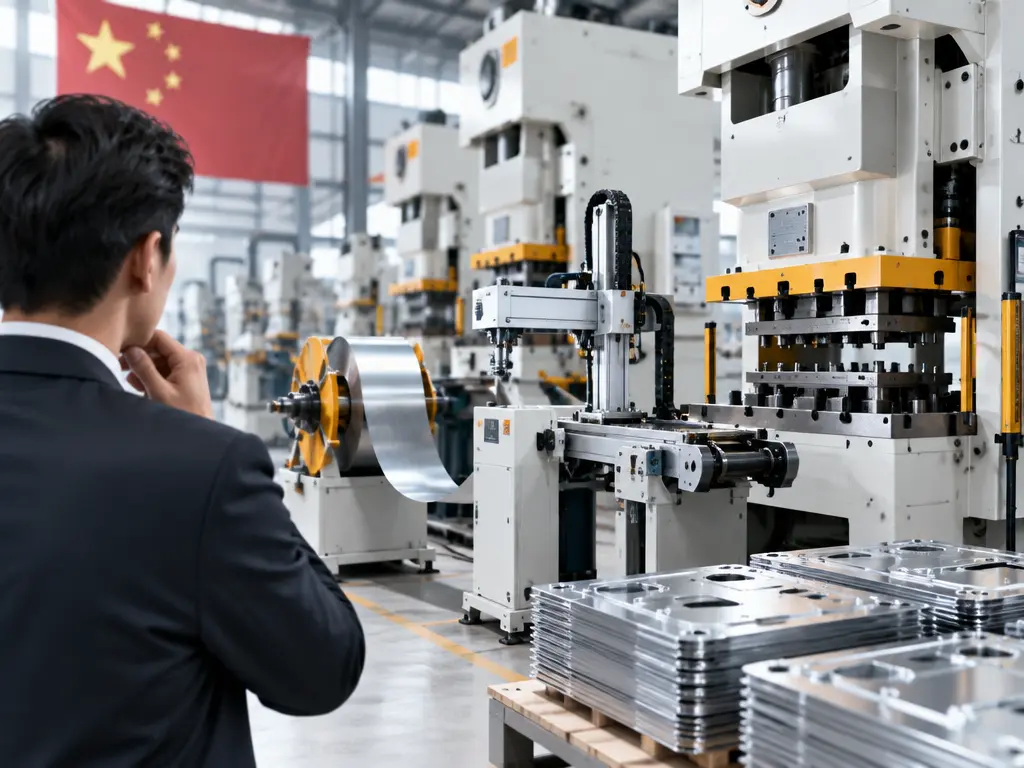
If you’re reading this, you’re probably considering sourcing stamping automation equipment from China — and trying to pick the right Chinese stamping manufacturer out of thousands of suppliers. You’re not alone. China produces roughly 60% of the world’s press feeding equipment — NC servo feeders, leveling machines, decoilers, and complete stamping lines — and exports them to manufacturers in over 100 countries.
The question isn’t whether to buy from a Chinese stamping manufacturer. It’s how to identify the right one and avoid the wrong one. For an overview of the broader manufacturing context, see Wikipedia’s manufacturing in China article.
Why Source Stamping Equipment from a Chinese Stamping Manufacturer?
Three structural advantages make a Chinese stamping manufacturer the dominant force in this market:
1. Manufacturing Cluster Economics
The Pearl River Delta — particularly Foshan Shunde, Dongguan, and Shenzhen — forms the world’s densest stamping automation equipment manufacturing cluster. Hundreds of specialized component suppliers, machining shops, and assembly factories operate within a 100km radius. Consequently, this means shorter lead times for raw materials, competitive pricing for machined components, and deep pools of experienced technicians.
When you buy from a Shunde-based Chinese stamping manufacturer like Jingcui Automation, you’re buying from the center of this ecosystem.
2. Price-to-Performance Ratio
Chinese NC servo feeders with Mitsubishi or Yaskawa drives, precision-ground GCr15 rollers, and PLC control systems typically cost 30–50% less than comparable European or Japanese equipment — for equivalent or near-equivalent specifications.
The savings aren’t from cutting corners. Instead, they come from lower labor costs, cheaper raw materials, efficient cluster supply chains, and factory-direct sales models that eliminate multiple layers of distributor markup.
3. Export Experience and Tariff Advantages
Chinese stamping equipment exports to Southeast Asian countries (Vietnam, Thailand, Indonesia) benefit from zero tariffs under ACFTA and RCEP trade agreements. Meanwhile, for Middle Eastern markets, GCC unified tariffs are typically 5% — competitive with any sourcing region.
Factory vs. Trading Company: How to Tell the Difference
This is the single most important distinction when sourcing from China.
A factory (like Jingcui) designs, machines, assembles, and tests its own equipment. You’re buying directly from the manufacturer. In contrast, a trading company buys from factories and resells — adding margin, obscuring the real manufacturer, and often unable to provide technical support.
Signs You’re Dealing with a Real Factory:
- ✅ They can send you photos and videos of their workshop floor — not just product photos
- ✅ They can provide detailed technical drawings and specifications specific to your application
- ✅ They have a physical factory address you can visit, with real production equipment
- ✅ Their technicians can answer detailed technical questions during video calls
- ✅ They have documented export history with references from past international customers
Signs You’re Dealing with a Trading Company:
- ❌ They claim to manufacture “everything” — dozens of unrelated product categories
- ❌ They can’t provide factory floor photos or videos that match their claimed scale
- ❌ Technical questions get vague answers or long delays (“need to check with our engineer”)
- ❌ Their website shows stock photos, not actual factory images
- ❌ Prices are suspiciously low for the claimed specifications
8 Criteria to Evaluate a Chinese Stamping Manufacturer
1. Years in Business
In this industry, experience matters. Stamping feeding equipment is precision machinery — the difference between a 5-year-old startup and a 22-year veteran like Jingcui shows up in engineering depth, production consistency, and after-sales capability.
2. Factory Size and Equipment
Ask for factory photos. Look for: CNC machining centers, lathes, grinding machines, assembly bays, and testing areas. A real manufacturer invests in production equipment. A trading company has a showroom. See Jingcui’s factory tour.
3. Product Range Depth
A manufacturer with a full product range across 6 series covering every stage of stamping automation (like Jingcui) demonstrates genuine R&D investment. Conversely, a so-called Chinese stamping manufacturer with a handful of models and no custom capability is likely reselling.
4. Custom Engineering Capability
Can they design non-standard configurations for your specific material, press, and die? A real Chinese stamping manufacturer has an engineering team that can review your application and propose a verified configuration — not just ship a standard model and hope it works. For example, the difference shows up when your material, press, and die don’t match any catalog entry.
5. Quality Certifications
Look for ISO 9001 quality management certification. For equipment going to the EU, CE certification is mandatory. Ask to see the actual certificates, not just a logo on the website.
6. Export Track Record
Which countries have they exported to? Can they provide references from past international customers? A manufacturer with export history to Southeast Asia, the Middle East, or South America has proven their ability to handle international logistics, documentation, and after-sales support.
7. English Communication Capability
Do their sales engineers communicate clearly in English? Can they produce technical documentation, manuals, and certificates in English? Miscommunication during specification causes expensive mistakes.
8. After-Sales Support
What happens when your feeder has an issue six months after delivery? Can they send an engineer to your country? Do they offer remote video diagnosis? What’s their spare parts availability policy? At Jingcui, we offer: engineer dispatch for overseas installation and training, 24/7 remote technical support, genuine OEM spare parts, and lifetime technical support. Above all, we stand behind our equipment long after the invoice clears.
Shunde: Why the Right Chinese Stamping Manufacturer Is Here
Not all Chinese manufacturing regions are equal for stamping equipment. Shunde District, Foshan is the undisputed center of China’s stamping automation industry, and it’s where the strongest Chinese stamping manufacturer options are concentrated. Here’s why it matters:
- Supply chain density: Specialized component suppliers (rollers, servo motors, PLCs, hydraulic systems) are concentrated within 50km. This means shorter lead times and better component quality.
- Technical talent pool: Generations of engineers and technicians trained in stamping automation work in this region.
- Industry knowledge concentration: When you buy from a Shunde manufacturer, you’re tapping into 30+ years of accumulated stamping automation expertise.
Jingcui Automation has been manufacturing in Shunde for 22 years — we didn’t move here for the brand. We grew here. Read our about us.
Red Flags to Watch For
- 🚩 They can’t provide a factory visit (even a virtual video tour)
- 🚩 Prices that are 30%+ below market average for the stated specifications
- 🚩 They ask for 100% payment upfront (standard is 30% deposit, 70% before shipment)
- 🚩 No English technical documentation or manuals available
- 🚩 Unable to answer basic technical questions about feed accuracy or roller materials
- 🚩 No export packing experience — international freight requires proper wooden crate packing
The Jingcui Difference: A Proven Chinese Stamping Manufacturer
Jingcui Automation is not a trading company. We are a factory-direct Chinese stamping manufacturer of stamping automation equipment, operating from our own smart factory in Shunde, Foshan since 2003.
- 22 years of continuous operation
- 12 patents including 1 software copyright plus invention and utility model patents
- 30 product models across 6 series — feeders, levelers, decoilers, 3-in-1 lines, robots, and equipment
- Turnkey line capability — we don’t just sell machines, we design and deliver complete stamping automation lines
- Proven export history to Southeast Asia, the Middle East, and South America
- Overseas installation support — our engineers travel to your factory for setup and training
We invite factory visits. We’ll walk you through our CNC machining area, assembly bays, and testing stations on a video call. We’ll configure your feeding line based on your actual press, die, and material data — not a standard spec sheet.
Frequently Asked Questions
How do I choose a Chinese stamping manufacturer?
Verify they’re a real factory, not a trading company. Specifically, check years in business, factory photos, product range depth, custom engineering capability, certifications, export track record, English communication, and after-sales support. A factory-direct Shunde Chinese stamping manufacturer is your best starting point.
How do I verify a Chinese stamping manufacturer is legitimate?
A factory designs, machines, and tests its own equipment; a trading company resells from factories, adds margin, and often can’t provide technical support. Look for workshop photos, detailed drawings, and direct technical answers to tell them apart.
Is Chinese stamping equipment reliable?
Yes, from the right manufacturer. Chinese factories using Mitsubishi/Yaskawa drives and precision-ground GCr15 rollers deliver European/Japanese-equivalent specs at 30–50% lower cost. The key is choosing a factory-direct supplier with proven export history.
Why is Shunde, Foshan important for stamping equipment?
Shunde is the center of China’s stamping automation cluster — dense supply chains, deep technical talent, and 30+ years of accumulated expertise, all within 50km. Buying from a Shunde factory means shorter lead times and better component quality.
How much should I expect to pay?
Depends on your configuration. A basic NC servo feeder runs $3,000–$8,000; a complete turnkey line $40,000+. For detailed ranges, see our coil feeding system cost guide, and for equipment selection, our NC servo feeder buying guide.
Ready to source stamping automation equipment from China? Start with a factory-direct conversation.
Contact Jingcui Automation with your requirements. We’ll send you a factory video tour, discuss your application with our engineers, and provide a verified technical proposal — all before you commit a dollar.
📞 WhatsApp: +86 133 6064 4989 | 🌐 jingcuiautomation.com

Leave a Reply