

The stamping industry is in the middle of a significant shift. Rising labor costs, tighter customer quality requirements, and the global push toward “machine replacing human” are driving factory owners worldwide to upgrade their press lines. By mid-2026, several clear stamping automation trends have emerged that will shape equipment purchasing decisions for the next five years.
If you’re planning a line upgrade or a new factory setup, here’s what’s happening — and what it means for your shop. For background on the forming process, see Wikipedia’s stamping article.
Trend 1: Servo Press Adoption Is Accelerating — a Stamping Automation Trend to Watch
Servo-driven mechanical presses, which use servo motors instead of traditional flywheel-and-clutch mechanisms, are the fastest-growing segment in press technology. The global servo press market was estimated at $2.6 billion in 2025 and is projected to reach $4.45 billion by 2036 (Fact.MR, CAGR 5.0%).
Why this matters for feeding equipment: Servo presses can vary speed and stroke mid-cycle, offering programmable motion profiles. However, to take advantage of this flexibility, the feeding system must also be servo-driven and capable of electronic synchronization. A pneumatic feeder connected to a servo press is like putting bicycle tires on a sports car — the press can’t perform at its capability.
The practical implication: if you’re buying a servo press, budget for an NC servo feeder as part of the same project. The two are now a matched pair. This is one of the clearest stamping automation trends to act on. Browse our feeders category.
Trend 2: Compact 3-in-1 Lines Are a Stamping Automation Trend Replacing Traditional Setups
The separate decoiler + leveler + feeder configuration — standard for decades — is giving way to integrated 3-in-1 compact coil feed lines. The driving force isn’t just floor space savings (though saving 40% matters in crowded press rooms). It’s also:
- Faster changeovers: One HMI controls everything instead of three separate controllers
- Better strip tracking: Shorter material path = less chance of edge damage
- Simpler maintenance: One machine to maintain instead of three
- Single-source responsibility: When something goes wrong, one phone call
For shops adding their first automated line or upgrading from manual feeding, a 3-in-1 unit is increasingly the default starting point — not the premium option. Consequently, this ranks among the most practical stamping automation trends for smaller factories.
Trend 3: Robot Integration Is a Stamping Automation Trend Going Mainstream
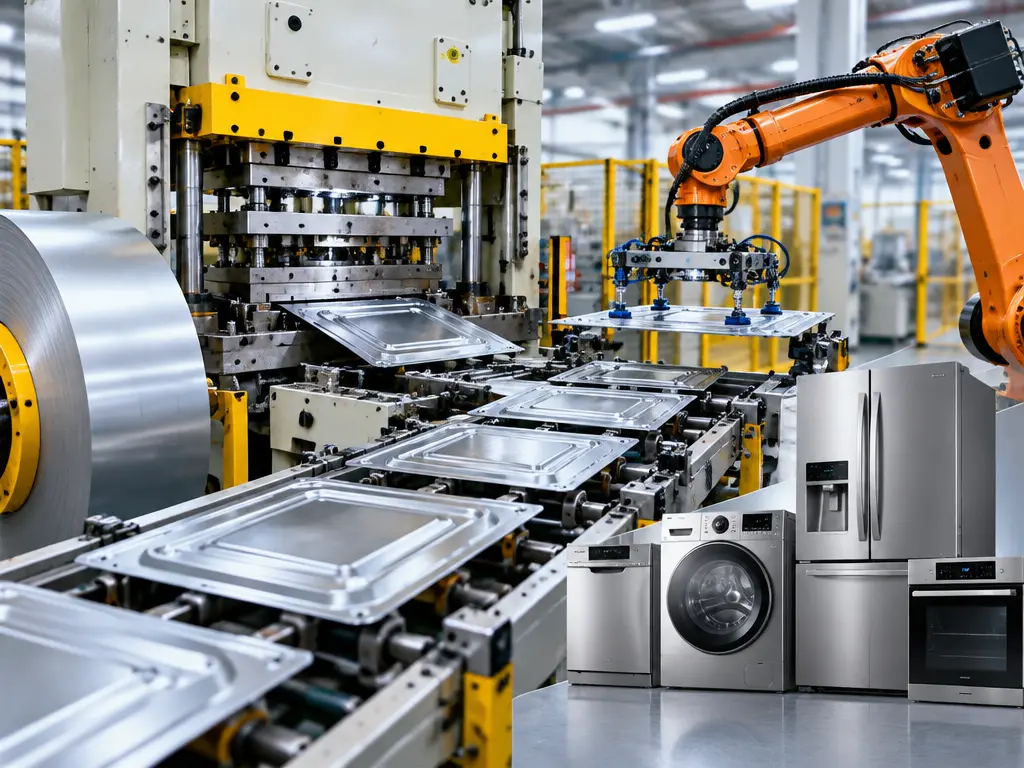
Five years ago, stamping robots were something you saw at automotive Tier 1 suppliers and large appliance factories. Today, in contrast, they’re showing up in mid-sized shops running 3–10 presses.
The economics have shifted:
- Robot costs have dropped: A 6-axis stamping handling robot with 10kg payload now costs roughly the equivalent of 12–18 months of one operator’s salary in many countries
- Labor availability is decreasing: In Vietnam, Thailand, and even India, finding and retaining press operators is harder than it was five years ago
- Quality consistency: Robots don’t get tired, don’t take breaks, and don’t drop parts on Friday afternoons
Jingcui’s 6-axis handling robot (1650mm reach, ±0.05mm repeatability) integrates with our feeding systems to create a complete press cell. One operator oversees the line. The robot does the repetitive work.
Trend 4: High-Strength Steel Is Driving New Stamping Automation Trends in Specs
The automotive industry’s push for lighter, safer vehicles has made HSS and advanced high-strength steel (AHSS) mainstream. But it’s not just automotive — appliance manufacturers are also spec’ing thinner, stronger steels to cut material costs and meet energy efficiency standards.
For stamping equipment, HSS means several upgrades. Because these stamping automation trends shift material specs, you now need:
- Levelers with more rolls and higher rigidity to flatten stronger, springier material
- Feed rollers with higher hardness (HRC 60+) and better surface treatment
- Decoilers with more torque to handle heavier coils of denser material
- Servo motors with more power to advance strip with higher friction coefficients
If your current line was spec’d for mild steel and you’re moving into HSS parts, get an engineering review. After all, the upgrade cost is modest compared to the scrap and downtime from running the wrong equipment.
Trend 5: Developing Markets Are a Stamping Automation Trend to Watch
The biggest growth in stamping equipment demand isn’t in established manufacturing countries. It’s in the countries building their manufacturing capacity right now:
- Vietnam: FDI-driven manufacturing boom, zero tariffs on Chinese equipment (ACFTA/RCEP), new factories need complete lines
- Thailand: “Detroit of Asia” — 1,700+ auto parts Tier 2/3 suppliers upgrading equipment
- Saudi Arabia: Vision 2030 targeting 36,000 factories, zero local competition for stamping equipment manufacturing
- India: Massive market, but price-competitive — the right configuration at the right FOB price can win
For equipment buyers in these markets, the sourcing decision is increasingly: buy from China (best price-to-performance, factory-direct, experienced vendors) or from local/international brands (higher cost, but local support).
Chinese manufacturers like Jingcui that offer overseas installation, training, and remote support are closing the “local support” gap.
Trend 6: Digital Documentation Is the Quietest Stamping Automation Trend
It used to be that a stamping line just needed to make parts. Now, however, customers — especially in automotive and electronics — want to know:
- What was the feed accuracy on batch #2473?
- How many mis-feeds occurred in the last shift?
- When was the last leveler roll maintenance performed?
NC servo feeders with PLC control can log this data. The HMI stores job recipes, alarm history, and cycle counts. This isn’t “Industry 4.0” hype — it’s what IATF 16949 auditors look for during factory visits.
When you’re buying new feeding equipment, ask about data logging capability. Even if you don’t need it today, your customer might require it next year.
What These Stamping Automation Trends Mean for Your Next Purchase
If you’re planning to buy stamping automation equipment in 2026 or 2027, here’s a practical checklist:
- ✅ Go servo — If you’re still using pneumatic or mechanical feeders, upgrade to NC servo. The ROI is clear.
- ✅ Consider compact — For new lines or major upgrades, evaluate 3-in-1 units first. They’re often the right answer.
- ✅ Plan for robots — Even if you don’t buy a robot now, leave space in your layout and budget for one in 2–3 years.
- ✅ Spec for HSS — Give yourself 20–30% headroom on material strength. The cost difference is small; the future-proofing value is large.
- ✅ Verify export capability — If you’re sourcing from overseas, make sure your supplier has proven export experience, proper packing, and overseas support capability.
Jingcui’s Role in the 2026 Automation Landscape
At Jingcui Automation, we’ve been watching these trends develop from our factory floor in Shunde, Foshan for 22 years. Our equipment portfolio — NC servo feeders, precision levelers, 3-in-1 compact lines, material racks, and handling robots — is designed around the direction the industry is heading, not where it’s been. Above all, we build for the factory of tomorrow, not the factory of yesterday.
We offer factory-direct pricing, factory-tested equipment, and factory-direct technical support — including engineers who can travel to your location for installation and training. That’s how you stay competitive in a market that changes every year.
Frequently Asked Questions
What are the biggest stamping automation trends in 2026?
The six key trends are: servo press adoption, 3-in-1 compact lines replacing three-machine setups, robot integration going mainstream, high-strength steel changing equipment specs, developing markets building new factories, and digital traceability becoming baseline.
Should I upgrade from pneumatic to servo feeding?
For most progressive-die and high-volume operations, yes. NC servo feeders hold ±0.15mm accuracy versus ±0.5mm for pneumatic, cut scrap roughly in half, and pay back within months. See our pneumatic-to-servo ROI guide.
Are 3-in-1 compact lines worth it?
For most general stamping, appliance, and automotive applications, a 3-in-1 saves about 40% floor space and speeds changeovers. Learn more in our 3-in-1 guide.
How is high-strength steel changing equipment requirements?
HSS requires more leveling rolls, HRC 60+ hardened rollers, higher clamping pressure, and more servo torque. If your line was spec’d for mild steel, get an engineering review before running HSS.
Where is stamping equipment demand growing fastest?
Vietnam, Thailand, Saudi Arabia, and India are the fastest-growing markets, driven by FDI, tariff advantages, and industrial expansion. For cost guidance, see our coil feeding system cost guide.
Planning a stamping line upgrade for 2026 or 2027?
Let’s talk about what makes sense for your factory. Contact Jingcui Automation with your current setup and future goals — we’ll recommend a configuration that works for today and tomorrow.
📞 WhatsApp: +86 133 6064 4989 | 🌐 jingcuiautomation.com


Leave a Reply