
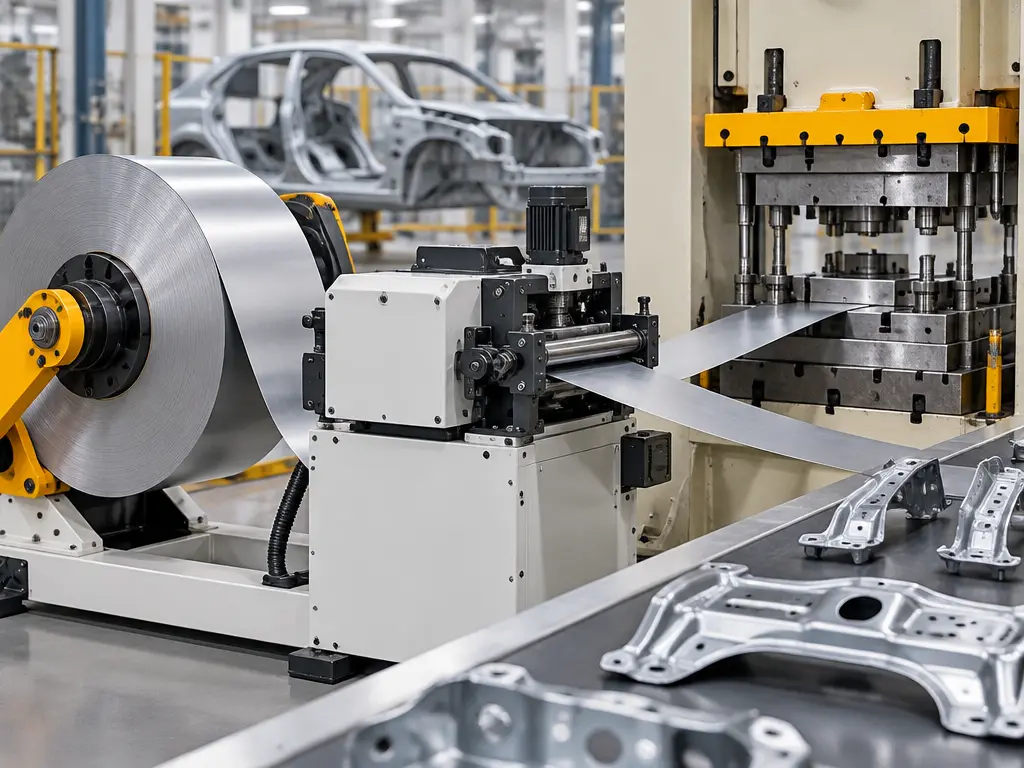
If you supply stamped parts to the automotive industry, you already know the bar is higher. Tolerances are tighter, traceability matters, and your customer’s audit team will check everything — including your feeding equipment. This is exactly why an automotive stamping feeder matters.
An automotive stamping feeder has become the standard for one simple reason: mechanical and pneumatic feeders can’t consistently deliver the accuracy and repeatability that automotive Tier 1 and Tier 2 suppliers demand. For background on the forming process, see Wikipedia’s stamping article.
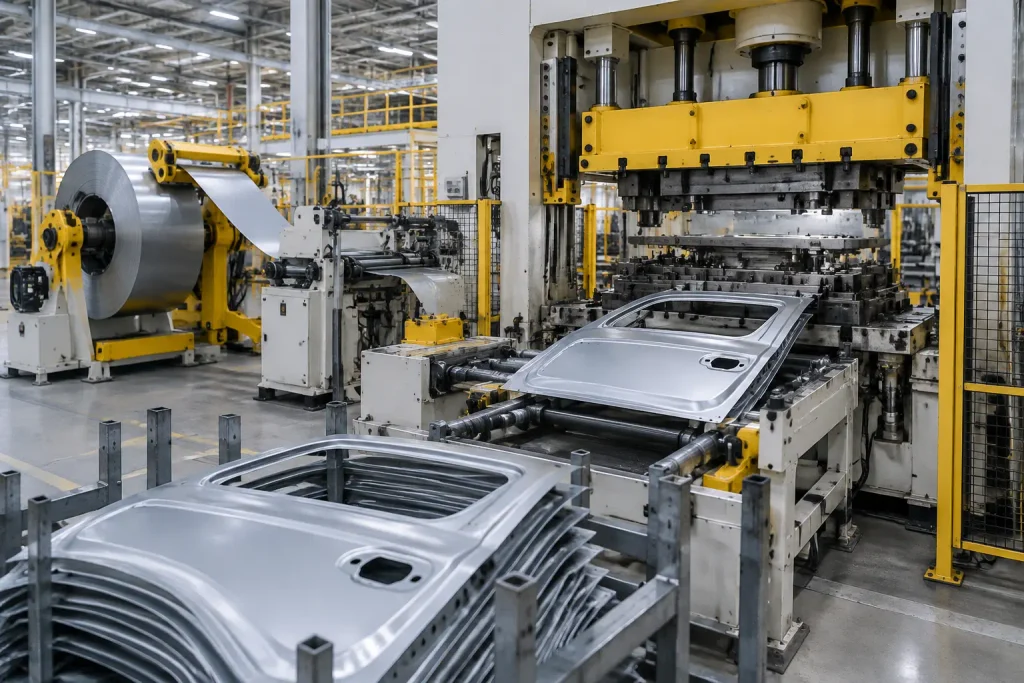
Why Automotive Stamping Needs an NC Servo Feeder
Three factors make automotive different from general stamping:
Tighter Tolerances
A seat frame bracket with ±0.3mm positional tolerance on mounting holes requires the strip to be fed within ±0.15mm or better. In fact, any variation in feed length translates directly to hole position — and a rejected batch.
Pneumatic feeders, even well-maintained ones, typically deliver ±0.5mm at best. In contrast, an automotive stamping feeder with closed-loop encoder feedback holds ±0.15mm consistently across thousands of cycles.
High-Strength Steel (HSS) and Advanced Materials
Modern vehicles use HSS, dual-phase steel, and aluminum to reduce weight while maintaining crash safety. These materials are harder, springier, and more demanding on feeding equipment. Consequently, the feed rollers need higher clamping force, the straightener needs more roll stations, and the servo motor needs more torque — all of which your automotive stamping feeder must be sized for.
Traceability Requirements
IATF 16949 certification — mandatory for automotive suppliers — requires process monitoring and data logging. NC servo feeders with PLC control can track feed count, alarm history, and recipe changes, generating the documentation auditors look for. In other words, a well-chosen automotive stamping feeder doubles as a compliance record.
Typical Automotive Parts Produced with an Automotive Stamping Feeder
| Part | Material | Typical Thickness | Key Challenge |
|---|---|---|---|
| Seat frame brackets | HSS / DP steel | 1.2–2.5mm | Tight hole position tolerances |
| Door hinge components | Mild steel | 2.0–4.5mm | Thick material leveling |
| Brake pad backing plates | Stainless / coated steel | 3.0–5.0mm | High clamping force needed |
| Exhaust system brackets | Stainless steel | 1.0–2.0mm | Springy material, needs precision leveling |
| Engine mount brackets | HSS | 2.0–4.0mm | High-strength material, multi-stage feeding |
| Transmission components | Mild steel / alloy | 1.5–3.0mm | Complex progressive dies, tight pitch |
| Chassis reinforcement plates | HSS / UHSS | 2.0–6.0mm | Heavy plate leveling, wide material |
Each of these parts presents a different combination of width, thickness, material strength, and pitch. Consequently, automotive feeding lines are almost always custom-configured, not off-the-shelf.
How to Configure an Automotive Stamping Feeder for Car Parts
1. Start with the Material Grade
The yield strength and tensile strength of your material directly determines the leveling force and feed roller clamping pressure needed. Don’t just spec “steel” — provide the actual grade (e.g., DP590, DP980).
Jingcui’s engineering team uses this data to calculate roll deflection, motor torque requirements, and frame stiffness for every project.
2. Size the Leveler for the Toughest Job
If your production mix includes both 0.8mm mild steel AC duct brackets and 3.5mm HSS chassis plates, size the leveler for the 3.5mm HSS. Otherwise, a leveler that’s undersized for your most demanding material will produce wavy strip that causes die misalignment. In other words, the automotive stamping feeder must be matched to the toughest job, not the average one.
Our heavy plate levelers with 11-roll configuration and backup roll support handle up to 6mm thickness in mild steel and 3.5mm in HSS.
3. Match the Feeder to Press Speed and Pitch
A progressive die running at 35 SPM with a 250mm pitch needs a feeder that can advance 250mm in roughly 0.8 seconds (allowing for press dwell time). Check the feeder’s speed curve — not just the headline number — to verify it meets your actual operating point. Browse our feeders category.
4. Plan for Coil Changeovers
Automotive stampers often run batch sizes of 5,000 to 50,000 parts. Coil changes happen frequently. A hydraulic expansion decoiler with a coil car can reduce changeover time from 15 minutes to under 5, adding up to hours of extra production per week.
The Robot Factor: From Feeding to Full Automation
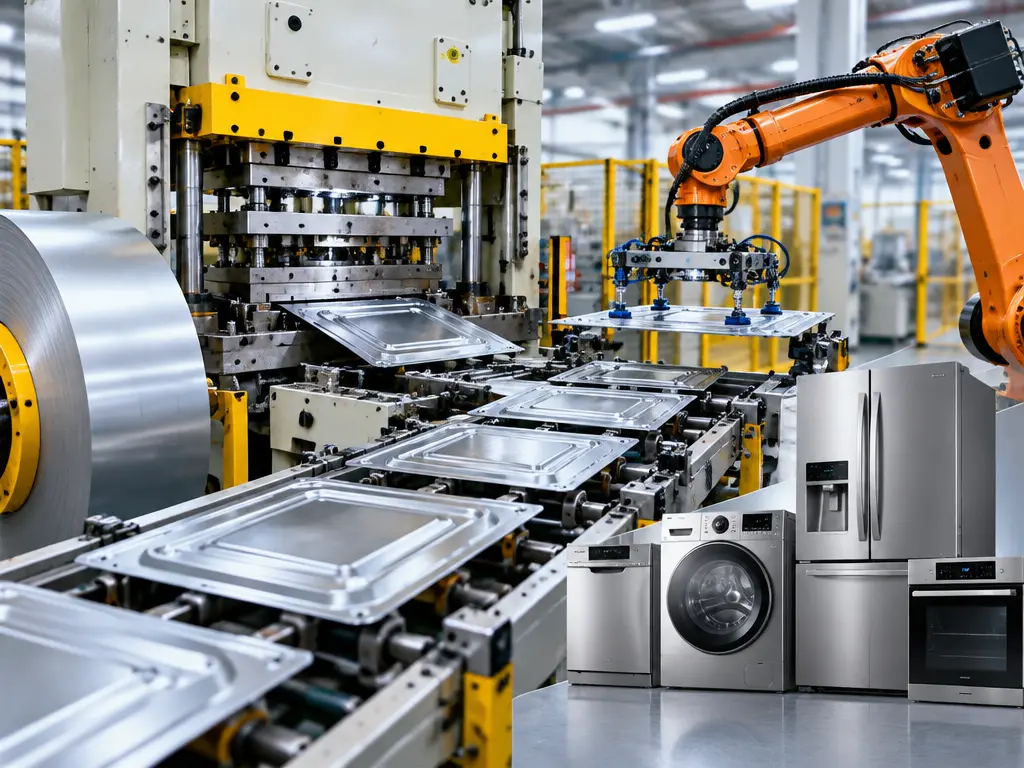
For automotive parts, the feeding system is often just one component of a larger automated cell. A typical high-volume automotive stamping cell might include:
- Hydraulic decoiler with coil car
- Precision leveler with 11-roll cassette
- NC servo feeder synchronized to press encoder
- 6-axis handling robot picking finished parts and stacking onto pallets
- Conveyor system moving finished pallets to quality inspection
Jingcui’s 6-axis high-speed stamping robot (10kg payload, 1650mm reach, ±0.05mm repeatability) integrates with our feeding systems to create a complete “coil to pallet” production cell — one supplier, one control architecture, one warranty.
HSS Handling: What Changes
If you’re feeding high-strength steel (yield strength >400 MPa), the feeding line needs several upgrades over a standard mild steel configuration. In fact, this is where a dedicated automotive stamping feeder with hardened rollers earns its keep:
- Higher roller hardness: GCr15 bearing steel with HRC 60+ is minimum. Hard chrome plating recommended.
- More leveling rolls: 11 rolls minimum for HSS, with backup rolls to prevent deflection
- Higher clamping pressure: Pneumatic cylinder sizing must account for the higher friction coefficient of HSS
- Roller surface treatment: Nitrided or TiN-coated rollers for extended life with abrasive HSS surfaces
If you’re moving into HSS parts and your current feeder was spec’d for mild steel, get an engineering review before you run the first coil. After all, the cost of a roller upgrade is trivial compared to a die crash.
Jingcui’s Automotive Industry Experience
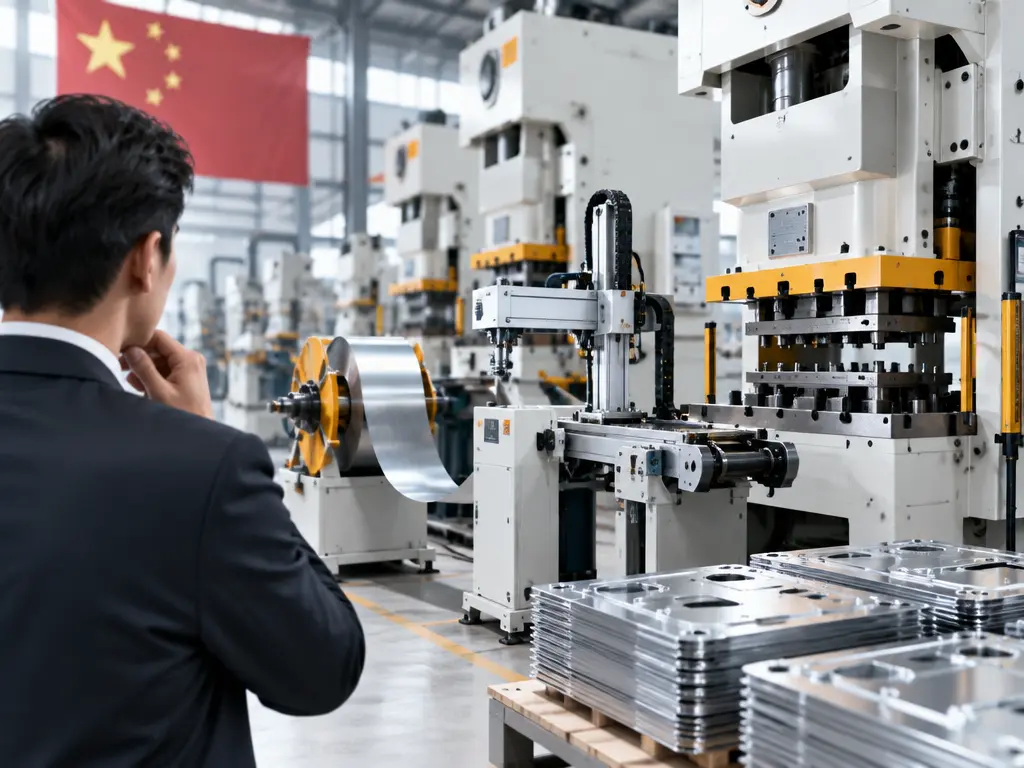
At Jingcui Automation, we’ve been supplying feeding systems to automotive parts manufacturers for over 22 years from our factory in Shunde, Foshan. Our equipment processes automotive stampings exported to Southeast Asia, the Middle East, and South America. Above all, every automotive stamping feeder we ship is spec’d to the actual part, not a generic catalog.
We understand the automotive supply chain requirements: IATF 16949 process control, material traceability, production documentation, and the relentless focus on consistent quality that defines automotive manufacturing.
Whether you need a single NC servo feeder for an existing press, or a complete turnkey line with robot handling, our engineering team will configure it around your specific parts, materials, and production targets.
Frequently Asked Questions
What is an automotive stamping feeder?
An automotive stamping feeder is an NC servo-driven unit that feeds strip material into a press for making car parts. It delivers the tight feed accuracy (±0.15mm or better) and traceability that automotive suppliers require, where pneumatic feeders fall short.
Why do automotive parts need servo feeders?
Automotive parts have tighter tolerances, use harder materials (HSS, dual-phase steel), and require IATF 16949 traceability. Servo feeders with closed-loop encoder feedback hold accuracy that pneumatic feeders can’t match.
Can an automotive stamping feeder handle high-strength steel?
Yes, with the right spec: HRC 60+ hardened rollers, 11+ leveling rolls with backup support, and higher clamping pressure. Confirm your thickness and material grade before ordering.
What tolerance can an automotive servo feeder hold?
Typically ±0.15mm for progressive dies with tight pilots, versus ±0.5mm for a well-maintained pneumatic feeder. The accuracy spec should be stated for your actual material and speed. Learn more in our NC servo feeder buying guide.
How does automotive stamping differ from general stamping?
Automotive demands tighter tolerances, stronger materials, and documented traceability. This usually means a custom-configured line. See how to lay one out in our stamping automation line guide.
Supplying stamped parts to the automotive industry?
Let Jingcui Automation review your feeding line configuration. Send us your part drawings, material specs, and press data — we’ll recommend a verified equipment configuration that meets automotive quality standards.
📞 WhatsApp: +86 133 6064 4989 | 🌐 jingcuiautomation.com


Leave a Reply