
Table of Content
If you run a stamping factory, you already know the feeding system makes or breaks your press line. For example, an NC servo feeder is the heart of modern press automation because it determines your accuracy, your throughput, and how many good parts come off the line every shift.
However, choosing the right NC servo feeder isn’t as simple as matching a width and hitting “order.” Material type, press speed, die configuration, and your future production plans all factor into the decision.
Therefore, this guide walks you through what to look for, what questions to ask, and how to avoid buying an NC servo feeder that under-performs the day you install it.
What Is an NC Servo Feeder?
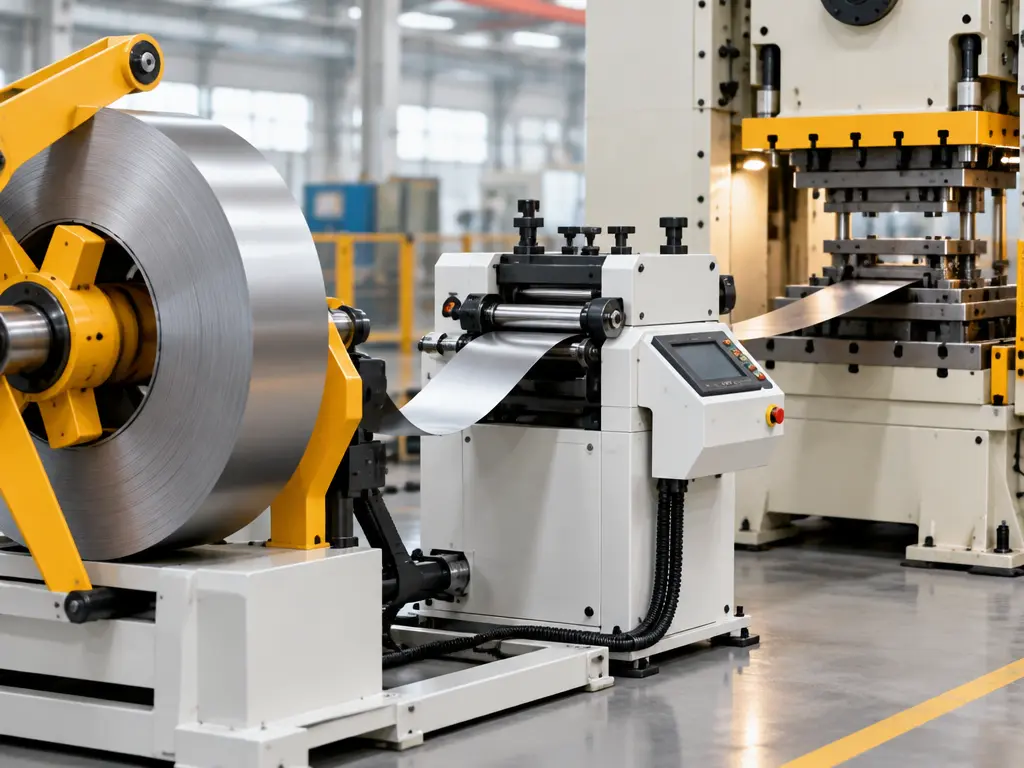
An NC (Numerical Control) servo feeder is a precision strip-feeding device that a servo motor drives and a programmable logic controller (PLC) controls. Unlike older pneumatic or mechanical feeders that rely on fixed cam-driven strokes, you can program a servo feeder for any feed length, speed, and acceleration profile — all through a touchscreen interface.
In simple terms: an NC servo feeder replaces guesswork and mechanical adjustments with digital precision. If you want a deeper background on the forming process itself, Wikipedia’s stamping article is a solid primer.
Key components of a typical NC servo feeder:
- Servo motor & drive — provides precise positioning, typically with encoder feedback for closed-loop control
- Feed rollers — hardened and ground rollers (often chrome-plated to HRC 60+) that grip and advance the strip
- Pilot release mechanism — momentarily releases roller pressure so the press die pilots can align the strip
- Touchscreen HMI — where you program feed length, speed, number of stages, and store job recipes
- Mounting base — adjustable height to match the press bolster
Key Specifications to Evaluate
When comparing NC servo feeders, focus on these five parameters. They determine whether a model will work for your parts — or cause production headaches.
1. Material Width Range
The feeder must accommodate your widest strip — and sometimes your narrowest. In other words, an NC servo feeder must cover your full job range, not just one width. A feeder rated for 100–600mm can handle a wider range of jobs than one fixed at 300mm. If you run multiple dies with different strip widths, choose a model that covers your full range.
Jingcui’s NCF series servo feeders covers 100mm up to 1300mm width, giving you room to grow without replacing the feeder later.
2. Material Thickness Range
Thin material (0.3mm) needs gentle, precise handling. Thick material (4.5mm+) needs stronger rollers and more motor torque. Check the feeder’s rated thickness window for your material grade — mild steel, stainless, aluminum, and HSS all behave differently.
3. Feed Length and Pitch
Servo feeders can typically handle anything from a few millimeters to several meters of feed length — all programmable. Likewise, an NC servo feeder with multi-stage capability adapts to every pitch on your die. The real question is: can it handle your shortest and longest pitches at your press speed?
Multi-stage feeding (up to 20 groups of different feed lengths on Jingcui NCF models) is essential if you produce parts with varying pitch requirements on the same die.
4. Feeding Accuracy
For general stamping, ±0.3mm accuracy is standard. Consequently, when you choose an NC servo feeder, you should verify the accuracy spec for your actual material and speed. For progressive dies with tight pilot tolerances, look for ±0.15mm or better. Make sure the manufacturer states the accuracy spec for your actual material and operating speed — not just in ideal lab conditions.
5. Feeding Speed
Measured in strokes per minute (SPM) or meters per minute, the servo feeder must keep up with your press. A feeder rated at 20 SPM with a 500mm pitch may not meet your needs if your press runs at 40 SPM. Always check the feeder’s speed rating at your maximum feed length. For context on how press speed and stroke work together, see Wikipedia’s press brake and forming machine overview.
Servo vs Pneumatic vs Mechanical Feeding
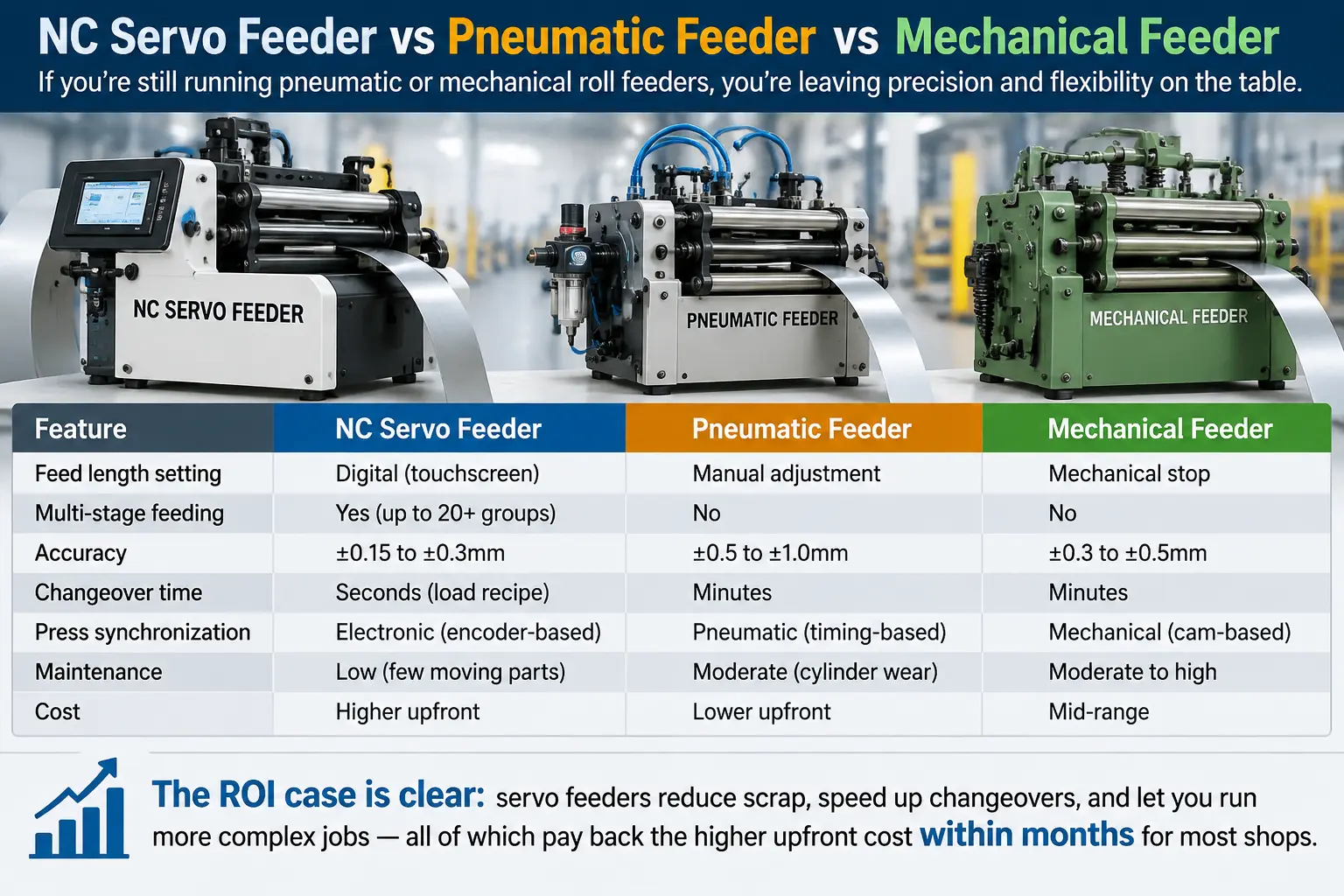
If you’re still running pneumatic or mechanical roll feeders, you’re leaving precision and flexibility on the table. Here’s how an NC servo feeder stacks up against the alternatives.
| Feature | NC Servo Feeder | Pneumatic Feeder | Mechanical Feeder |
|---|---|---|---|
| Feed length setting | Digital (touchscreen) | Manual adjustment | Mechanical stop |
| Multi-stage feeding | Yes (up to 20+ groups) | No | No |
| Accuracy | ±0.15 to ±0.3mm | ±0.5 to ±1.0mm | ±0.3 to ±0.5mm |
| Changeover time | Seconds (load recipe) | Minutes | Minutes |
| Press synchronization | Electronic (encoder-based) | Pneumatic (timing-based) | Mechanical (cam-based) |
| Maintenance | Low (few moving parts) | Moderate (cylinder wear) | Moderate to high |
| Cost | Higher upfront | Lower upfront | Mid-range |
The ROI case is clear because servo feeders reduce scrap, speed up changeovers, and let you run more complex jobs — all of which pay back the higher upfront cost within months for most shops.
How to Match a Servo Feeder to Your Press
Before you request quotes, gather these six data points. Specifically, the more precisely you document each one, the faster a supplier can verify the right configuration:
- Material — grade, yield strength, surface finish
- Strip dimensions — width range and thickness range (including min/max combinations)
- Coil details — weight, ID, OD (affects how the feeder integrates with your decoiler)
- Press specs — make, model, tonnage, SPM, bolster height
- Die information — feed pitch, number of pilots, strip layout
- Floor space — available area, feed direction, loading side
With these in hand, a manufacturer like Jingcui can verify the right NC servo feeder model and optionally design a complete coil feeding line — not just ship a machine that “should work.”
Questions to Ask Any Supplier
Not all feeders are built equal. In fact, a cheap NC servo feeder can cost more in scrap than it saves in price. Before you place an order, ask:
- What servo motor brand do you use? (Yaskawa, Mitsubishi, Panasonic are industry standards)
- What is the roller hardness and surface treatment? (Prefer HRC 60+ with hard chrome plating)
- Can you provide the accuracy curve at different feed lengths and speeds?
- Is the pilot release timing adjustable through the HMI?
- What is your standard warranty and spare parts availability?
- Do you offer on-site installation support?
If a supplier can’t answer these questions clearly, keep looking.
Why Jingcui NC Servo Feeders Are Built for Real Production
At Jingcui Automation, we’ve been designing and building NC servo feeders at our factory in Shunde, Foshan — the heart of China’s stamping automation manufacturing cluster — for over 22 years.
Our NCF series covers 100mm to 1300mm material width, handles 0–4.5mm thickness, and delivers ±0.3mm positioning accuracy with AC servo motor closed-loop control. Every NC servo feeder features:
- 20-group multi-stage feeding (up to 999 cycles per group)
- Pneumatic electronic relaxation synchronized with press cam signal
- Hollow-structured feed rollers with HRC 60+ hard chrome plating
- Touchscreen HMI with three-stage manual speed control
- 380V/415V three-phase power compatibility
We don’t just sell feeders. Instead, we configure them around your press, your material, and your production targets.
Frequently Asked Questions
An NC servo feeder is a strip-feeding device for stamping presses, driven by a servo motor and controlled by a PLC. It programs feed length, speed, and stage counts through a touchscreen, replacing mechanical or pneumatic feeders with digital precision.
The cost of an NC servo feeder depends on material width, thickness, feed length, and servo brand. Short-answer: a basic mid-range model costs less than a full 3-in-1 line. For a precise quote, send your material spec and press data — our coil feeding system cost guide covers a detailed breakdown.
“NC” and “CNC” are often used interchangeably when people talk about an NC servo feeder, but CNC technically implies a computer with more advanced interpolation. In practice, both refer to servo-driven, programmable feeding. See our 3-in-1 decoiler straightener feeder guide for how servo feeders integrate into a full line.
Typical accuracy is ±0.3mm for general stamping and ±0.15mm or better for progressive dies with tight pilots. For that reason, measure accuracy on your actual material at operating speed, not just in ideal conditions.
Yes — an NC servo feeder handles thick or HSS material when the model’s rating fits your thickness window. Thicker or HSS material requires stronger rollers and more motor torque, so confirm the thickness range before ordering.
Ready to spec your NC servo feeder?
Contact Jingcui Automation for a free, no-obligation configuration review. Send us your material specs, press data, and production goals — our engineers will recommend the right model and verify compatibility before you commit.
📞 WhatsApp: +86 133 6064 4989




Leave a Reply