
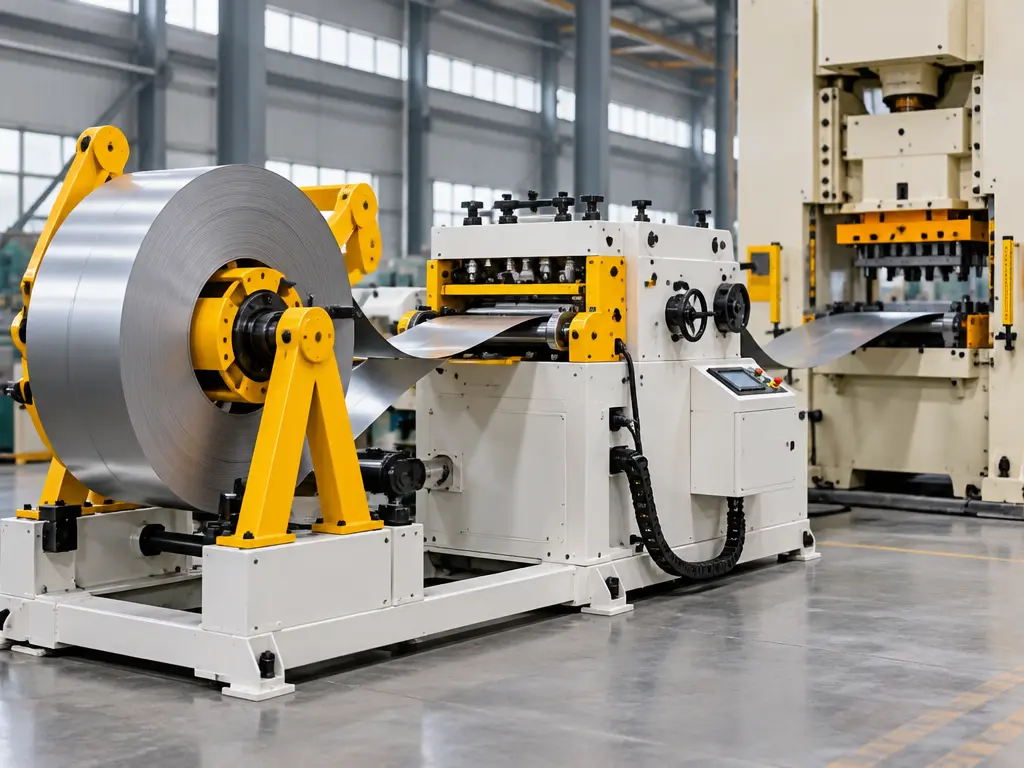
A decoiler straightener feeder — commonly called a 3-in-1 — is one of the smartest investments a stamping factory can make when floor space is tight, changeover time matters, and feeding consistency directly affects part quality. Instead of running three separate machines, a 3-in-1 decoiler straightener feeder combines all three functions into a single, synchronized unit.
For many shops, the difference shows up between cramming equipment into every corner of the press room and running a clean, efficient production cell with room to walk around.
Therefore, here’s what you need to know about how they work, why they’re worth it, and when they might not be the right fit.
What Exactly Is a Decoiler Straightener Feeder?
A decoiler straightener feeder (sometimes called a compact coil feed line or an integrated coil processing unit) handles three operations in sequence. For context on the underlying forming process, see Wikipedia’s metalworking stamping article. The three operations are:
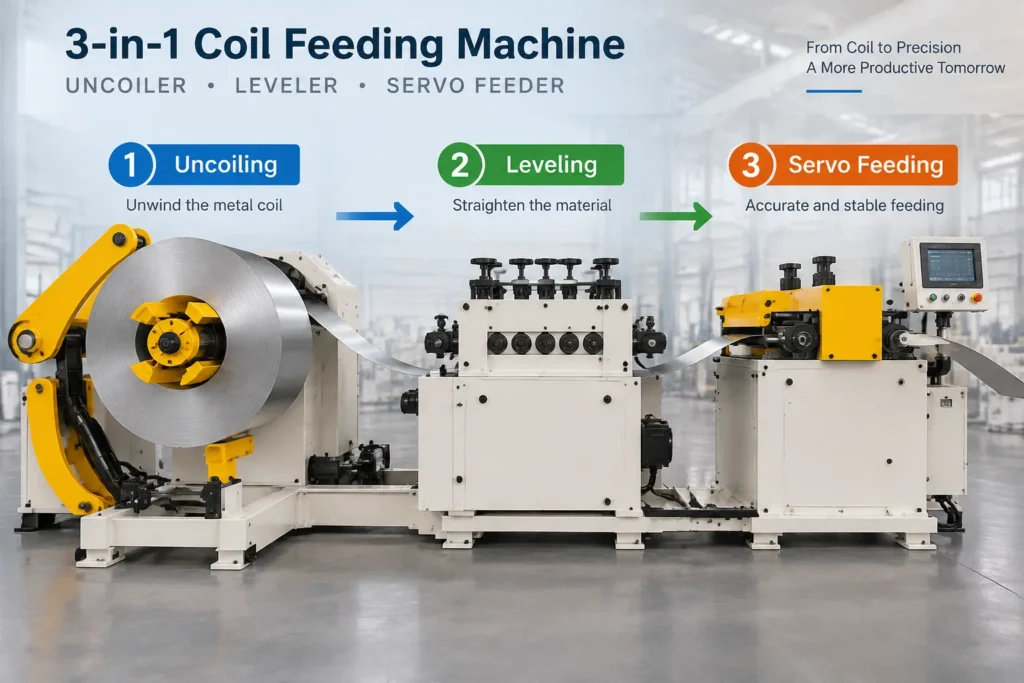
- Decoiling — A motorized mandrel or hydraulic expansion shaft holds and unwinds the coil under controlled tension. Specifically, the coil is loaded once, and the machine feeds the strip automatically.
- Straightening (Leveling) — The strip passes through a set of precision leveling rollers that remove the coil-set curvature. Without this step, curved material would feed unevenly into the die, causing misalignment and scrap.
- Servo Feeding — The straightened strip is advanced by precisely controlled servo-driven feed rollers, delivering the programmed pitch into the press for each stroke.
Everything sits on one frame, with one control system, one set of wiring, and one operator interface. In other words, you install one machine instead of three.
The Floor Space Math of a Decoiler Straightener Feeder
The single biggest reason factories switch to a decoiler straightener feeder: floor space.
A traditional three-machine setup takes up roughly 6–8 meters of linear floor space (decoiler + leveler + feeder, plus material loops between them). A 3-in-1 unit from Jingcui’s NLF1 series, by comparison, occupies approximately 4–5 meters in total length.
That’s roughly a 40% reduction in footprint. For a shop running 10 press lines, for example, that could mean freeing up 20–30 square meters — enough for another press, or just enough room to move materials and people efficiently.
Beyond Space: The Productivity Gains
Space savings are the visible benefit. However, the hidden ones are even more valuable:
Faster Changeover
On a traditional line, changing coils means coordinating three machines: retract the decoiler arm, thread the strip through the leveler, advance it into the feeder, set feed length on the feeder controller. In contrast, on a decoiler straightener feeder, it’s one sequence, one touchscreen, one operator.
Better Material Tracking
With fewer material loops and less distance between uncoiling and feeding, the strip stays aligned. Consequently, you get less edge damage, less variation in feed accuracy, and fewer mis-feeds that stop the press.
One Supplier, One Warranty
When the decoiler comes from one manufacturer and the feeder from another (and they were installed three years apart), troubleshooting a feeding issue becomes a blame game. Conversely, a 3-in-1 unit has one manufacturer. One phone call.
Key Specs: What to Look For in a Decoiler Straightener Feeder
When evaluating a decoiler straightener feeder for your shop, focus on these specs:
| Parameter | What Matters | Jingcui NLF1 Range |
|---|---|---|
| Material width | Must cover your widest strip | 50–400mm to 50–800mm |
| Material thickness | Across your full range | 0.2–3.2mm |
| Coil weight capacity | Must handle your heaviest coils | 3000–7000kg |
| Feed accuracy | Tighter = better for progressive dies | ±0.15mm |
| Line speed | Must keep up with press SPM | 16 m/min |
| Leveling rolls | More rolls = better flatness | 11 rolls (6 upper / 5 lower) |
| Mandrel expansion | Hydraulic preferred for heavy coils | Hydraulic |
| Coil ID/OD | Standard 508mm ID, 1200mm OD | Standard |
Important: Coil weight capacity and maximum width do NOT apply simultaneously. A unit rated for 7000kg coil and 800mm width typically cannot handle 7000kg at 800mm. Always check the operating envelope with your actual production specs.
When NOT to Use a Decoiler Straightener Feeder
3-in-1 machines are excellent for most applications — but, in fact, a decoiler straightener feeder isn’t always the answer. Consider these exceptions:
- Very thick material (>4.5mm): If you’re feeding 6mm hot-rolled steel, a dedicated heavy plate leveler with more roll stations may be needed.
- High-speed progressive stamping (>60 SPM): For ultra-high-speed applications, a separate gantry-style feeder with dedicated servo drives may be more suitable.
- Frequent die changes with different formats: If you switch between vastly different strip widths multiple times per shift, separate components may offer more flexibility.
- Very large coils (>10 tons): For heavy coil handling, a standalone heavy-duty decoiler with independent drive may make more sense.
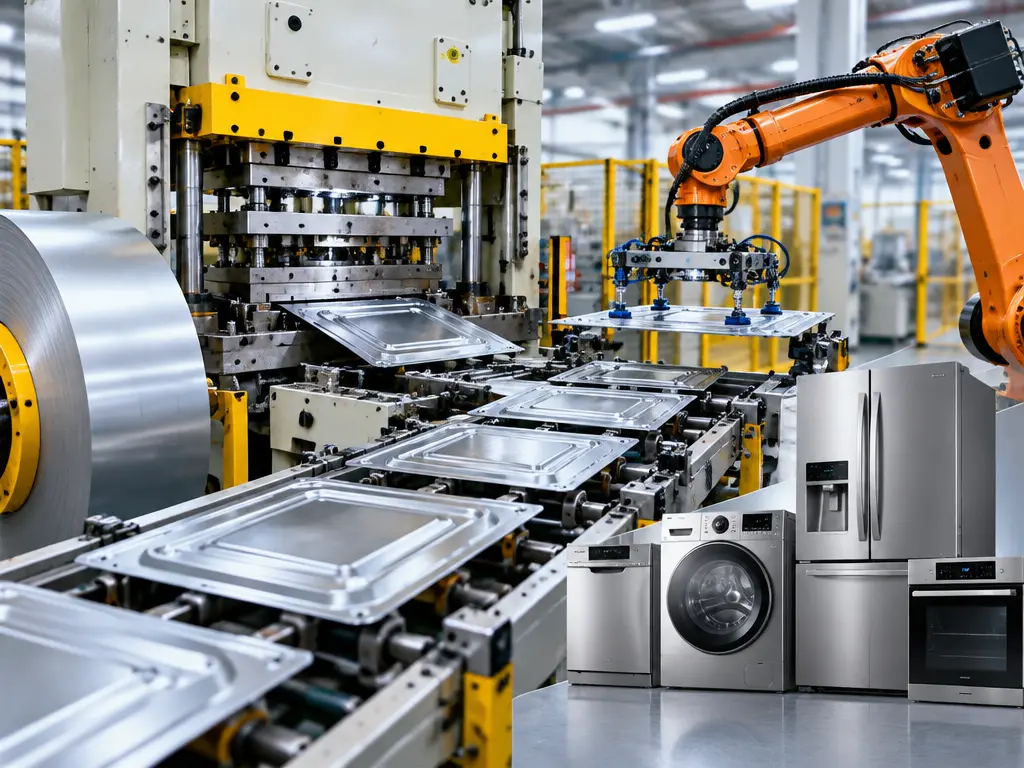
For everything else — general stamping, automotive parts, appliance panels, hardware, lighting fixtures — a decoiler straightener feeder is usually the right starting point.
A Real Decoiler Straightener Feeder in Production
A typical home appliance stamping shop running AC housing panels might have, for example:
- Material: Cold-rolled steel, 0.8mm thick, 500mm wide
- Coil weight: ~3–4 tons
- Press: 200-ton mechanical press at 35 SPM
- Die: Progressive die with 200mm pitch
With a Jingcui NLF1-500 (500mm width, 5000kg coil, ±0.15mm accuracy), this decoiler straightener feeder runs continuously. As a result, one operator loads coils, monitors the touchscreen, and checks parts. No separate decoiler or leveler to adjust. Meanwhile, changeover between coil runs takes under 5 minutes.
The Jingcui NLF Series: Built for Real Production
At Jingcui Automation, we’ve been manufacturing compact coil feed lines at our factory in Shunde, Foshan for 22 years. Our NLF series includes:
- NLF1-400 to NLF1-800: Standard range covering 50–800mm width, 3000–7000kg coil
- NLF2, NLF3, NLF4: Larger models for wider material and higher throughput
- CNC 3-in-1 models: For applications requiring higher precision and automated recipe management
Every NLF unit features hydraulic mandrel expansion for quick coil loading, 11-roll leveling cassette (6 upper / 5 lower), and Mitsubishi/Yaskawa-grade servo drive systems. Furthermore, they’re factory-tested before shipment and supported by our engineering team for on-site installation.
Frequently Asked Questions
What is a decoiler straightener feeder?
A decoiler straightener feeder (3-in-1) combines a decoiler, a leveler, and a servo feeder into one machine. It unwinds the coil, flattens the strip, and feeds it into the press at programmed pitch — all from a single frame and control system.
How much floor space does a 3-in-1 save?
Compared to three separate machines (decoiler + leveler + feeder), a 3-in-1 decoiler straightener feeder typically saves about 40% in linear floor space, turning a 6–8 meter setup into roughly 4–5 meters.
What material thickness can a 3-in-1 handle?
Jingcui’s NLF series covers 0.2–9.0mm across four models: NLF1 (0.2–3.2mm), NLF2 (0.5–4.5mm), NLF3 (0.6–6.0mm), and NLF4 (0.8–9.0mm). Thicker material above ~4.5mm may be better served by a dedicated heavy plate leveler.
Is a decoiler straightener feeder better than separate machines?
For most general stamping, appliance, and automotive applications, yes — a 3-in-1 offers space savings, faster changeovers, and single-source responsibility. Separate machines make more sense for ultra-high-speed lines, very heavy coils, or frequent extreme format changes. Learn more in our NC servo feeder buying guide.
What’s the difference between a 3-in-1 and a 2-in-1?
A 2-in-1 combines decoiling and leveling (no feeder); a 3-in-1 adds the servo feeding stage on top. Both are covered in our coil leveler guide.
Ready to see if a 3-in-1 fits your press line?
Contact Jingcui Automation with your material specs, coil data, and press details. Our engineers will verify the right model and configuration for your application — before you spend a dollar.
📞 WhatsApp: +86 133 6064 4989 | 🌐 jingcuiautomation.com


Leave a Reply