
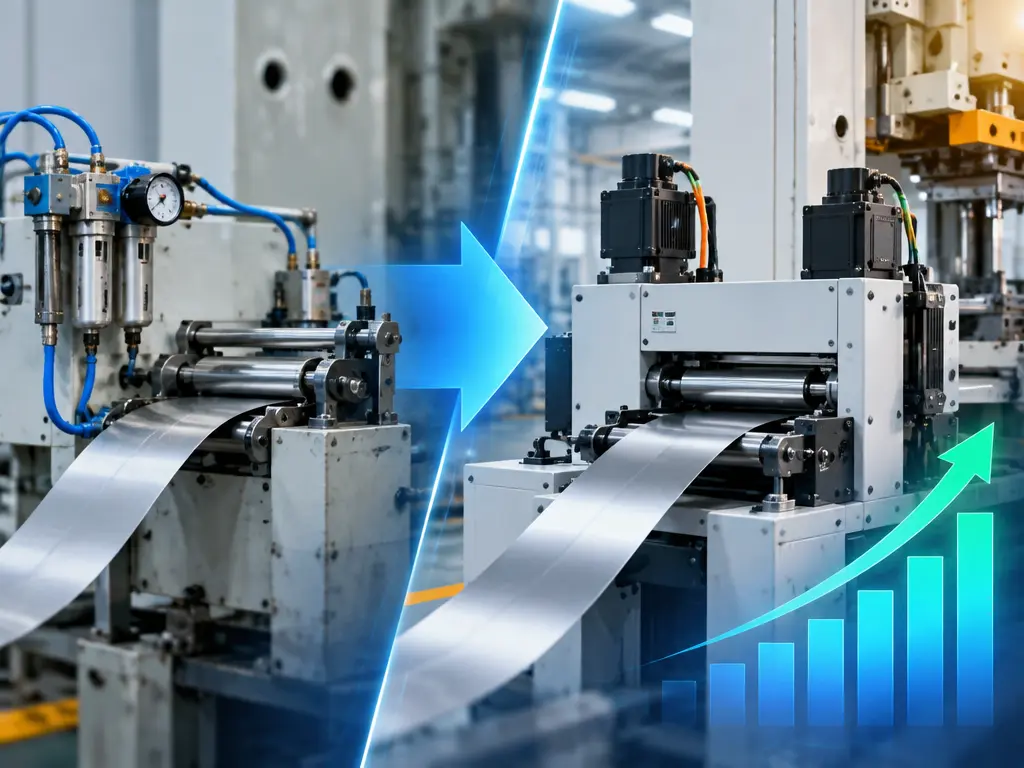
If your press shop is still running pneumatic or mechanical roll feeders, you’re probably aware of their limitations: inconsistent feed lengths, slow changeovers, limited multi-stage capability, and accuracy that drifts over a shift. The question isn’t whether upgrading from pneumatic to servo feeder is better — it’s when does the upgrade pay for itself?
For most stamping operations, the answer is: sooner than you think. For background on the forming process, see Wikipedia’s stamping article.
The Real Cost of Running Pneumatic Feeders (Why the Pneumatic to Servo Feeder Switch Pays)
Pneumatic feeders were the standard for decades. They’re simple, rugged, and cheap upfront. However, they have hidden costs that compound with every shift:
Scrap from Feed Length Drift
A pneumatic feeder’s accuracy depends on consistent air pressure, cylinder seal condition, and material surface friction. As cylinders wear and air pressure fluctuates, feed length drifts. For example, a 0.5mm drift on a part with ±0.3mm hole position tolerance means rejected parts — which is exactly why the pneumatic to servo feeder upgrade saves real money.
Typical scrap rate with pneumatic feeders: 2–5% Typical scrap rate with NC servo feeders: 0.5–1%
On a line producing 5,000 parts per shift at $2 material cost per part, reducing scrap from 3% to 1% saves $200 per shift — or about $50,000 per year on a single-shift operation. In other words, this single change alone often covers the pneumatic to servo feeder upgrade.
Changeover Time
Changing feed length on a pneumatic feeder means physically adjusting mechanical stops. Conversely, changing feed length on a servo feeder means typing a number on a touchscreen.
Changeover time comparison for a typical job change:
- Pneumatic feeder: 8–15 minutes (mechanical adjustment + trial runs)
- Servo feeder: Under 2 minutes (load recipe, verify first piece)
If you change jobs twice per shift, that’s 80–140 minutes saved per day — roughly one extra production hour. As a result, the pneumatic to servo feeder upgrade also recovers labor you’re currently spending on mechanical tinkering.
Limited Multi-Stage Capability
Some dies require different feed lengths at different stages — for example, a progressive die that feeds 200mm on the first stage, 180mm on the second, and 150mm on the third. Pneumatic feeders can’t do this without mechanical reconfiguration. Servo feeders, however, handle it through programmed recipes.
This means jobs that couldn’t run on your pneumatic-fed line can run on a servo-fed line — expanding your shop’s capability. In other words, the pneumatic to servo feeder switch unlocks work you currently turn away.
The Pneumatic to Servo Feeder Upgrade: ROI Breakdown
Let’s build a realistic ROI model for a mid-sized stamping shop upgrading one press line. Specifically, here are the assumptions we’ll use:
Assumptions
- Current: Pneumatic feeder, one-shift operation, 250 working days/year
- Press speed: 30 SPM average
- Parts per shift: ~5,000 (accounting for downtime)
- Material cost: $2 per part (average)
- Operator cost: $15/hour (loaded)
- New NC servo feeder cost: $4,500–$8,000 (depending on width/specs)
Annual Savings Calculation
| Source | Annual Savings | Calculation |
|---|---|---|
| Scrap reduction (3% → 1%) | $50,000 | 5,000 parts × $2 × 2% × 250 days |
| Changeover time savings | $7,500 | 10 min saved × 2 changes/day × $15/hr × 250 days |
| Total annual savings | $57,500 | — |
Payback Period
With a $6,000 average feeder cost, the payback period is roughly 6 weeks. Even on a small line with only $20,000 in annual savings, a servo feeder pays for itself within a few months.
The point isn’t the exact number for your shop — it’s the order of magnitude. In other words, pneumatic feeding’s hidden costs dwarf the upgrade price.
When Pneumatic Feeders Still Beat the Pneumatic to Servo Feeder Upgrade
Servo isn’t the right choice for every situation. Pneumatic feeders remain sensible for the following cases. However, the pneumatic to servo feeder upgrade still wins for most progressive-die work:
- Very low-volume applications: A shop running 50 parts per day simply may not recover the upgrade cost quickly
- Non-critical parts: Where feed length tolerance is ±2mm or looser
- Extremely thin or delicate materials: Where the gentler pneumatic action is preferable (though modern servo feeders handle these well too)
- Simple flat-blank operations: Where precision isn’t the bottleneck
But for progressive dies, tight-tolerance parts, multi-stage feeding, or any line running more than a few hundred parts per shift, NC servo is almost always the right call. Consequently, the pneumatic to servo feeder upgrade pays for itself in weeks, not years.
The Installation Process: What to Expect
Upgrading from pneumatic to servo is straightforward for most presses. The typical sequence goes like this:
- Verify press interface — Confirm encoder signal type, mounting height, feed direction
- Order the right model — Provide material width, thickness range, feed pitch, and press speed
- Installation — Typically 4–8 hours, including mounting, electrical connection, and signal integration
- Setup and training — Program feed parameters, test with material, train operators 2–4 hours
- Production — The line is back in operation, usually within 1–2 shifts total
Jingcui provides full installation guidance — remote support for standard setups, and on-site engineering support when required.
What About the Old Pneumatic Feeder?
Don’t scrap it. Instead, keep it as a backup for overflow work or as a spare if the servo feeder ever needs service. Many shops maintain one pneumatic feeder per 3–4 presses as emergency backup.
Alternatively, if it’s in good condition, sell it to recover a few hundred dollars toward the upgrade cost. There’s always a market for used but functional pneumatic feeders among shops that haven’t yet made the switch.
The Jingcui Pneumatic to Servo Feeder Upgrade Path
At Jingcui Automation, we’ve helped stamping shops in multiple countries upgrade from pneumatic and mechanical feeding to NC servo systems. Our NCF series servo feeders cover 100mm to 1300mm width, with ±0.3mm standard accuracy, 20-group multi-stage programming, and compatibility with all major press brands.
We’ll verify the right model for your press, coordinate the installation, and support you through the transition. And because we manufacture our own equipment in our Shunde, Foshan factory (22 years and counting), you’re buying factory-direct — no distributor markup, no middleman delays.
Frequently Asked Questions
Is upgrading from pneumatic to servo feeder worth it?
For most progressive-die and high-volume shops, yes. A servo feeder cuts scrap from 2–5% to 0.5–1%, cuts changeover time from 8–15 minutes to under 2, and typically pays for itself in about 6 weeks.
How much does a pneumatic to servo feeder upgrade cost?
A standard NC servo feeder costs $3,000–$8,000 depending on width and motor brand, with wide/heavy models up to $18,000. Compare against the annual scrap and changeover savings — usually $20,000–$57,000.
How long does a pneumatic to servo feeder upgrade take?
Installation is typically 4–8 hours, with setup and training adding 2–4 hours. Most lines are back in production within 1–2 shifts. See the full cost picture in our coil feeding system cost guide.
When is the pneumatic to servo feeder upgrade not worth it?
For very low-volume work, non-critical parts (±2mm tolerance), or delicate materials, pneumatic may still make sense. For everything else, servo wins. Learn how to choose in our NC servo feeder buying guide.
Can I keep my old pneumatic feeder?
Yes — keep it as a backup for overflow work or emergencies, or sell it to recover a few hundred dollars toward the upgrade.
Ready to calculate your upgrade ROI?
Send Jingcui Automation your current press specs, material data, and production volumes. We’ll recommend the right NC servo feeder and give you a realistic savings estimate — free, with no obligation.
📞 WhatsApp: +86 133 6064 4989 | 🌐 jingcuiautomation.com



Leave a Reply