
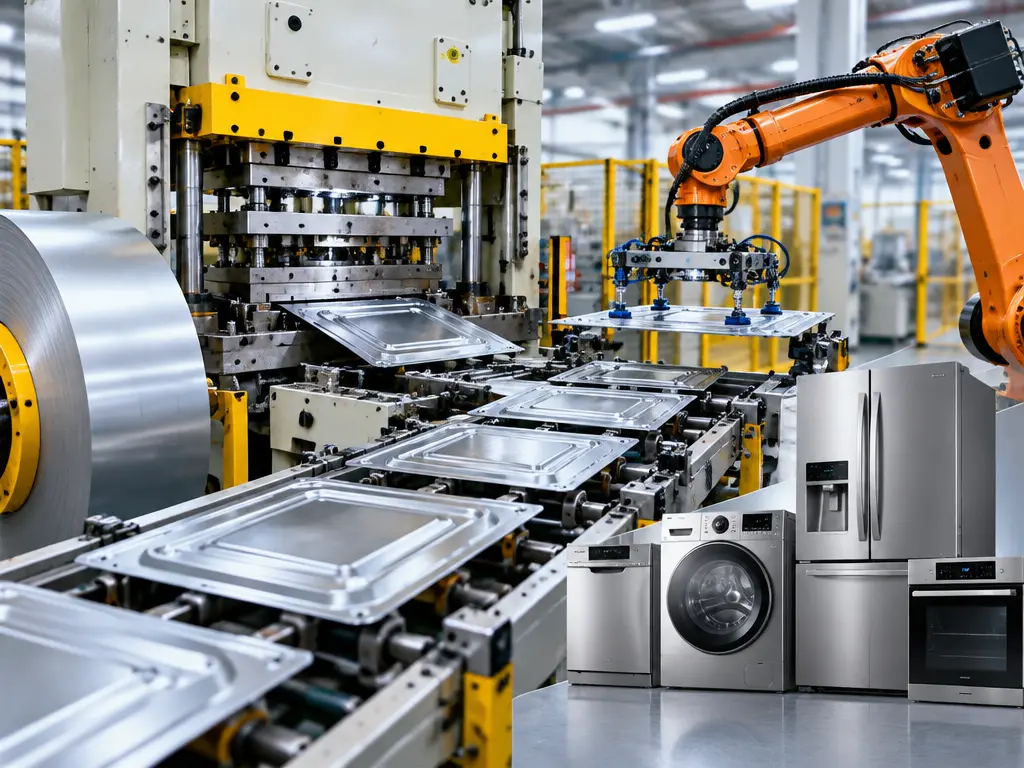
Home appliance manufacturing — air conditioners, refrigerators, washing machines, microwave ovens — lives on a unique combination of large panels, thin gauges, and relentless cost pressure. In short, home appliance stamping is a discipline of its own, where the lines must be fast, reliable, and efficient enough to keep per-part costs competitive.
For factory owners and production managers in this industry, choosing the right home appliance stamping equipment is the difference between running a profitable line and watching margins erode to scrap and downtime. For background on the forming process, see Wikipedia’s stamping article.
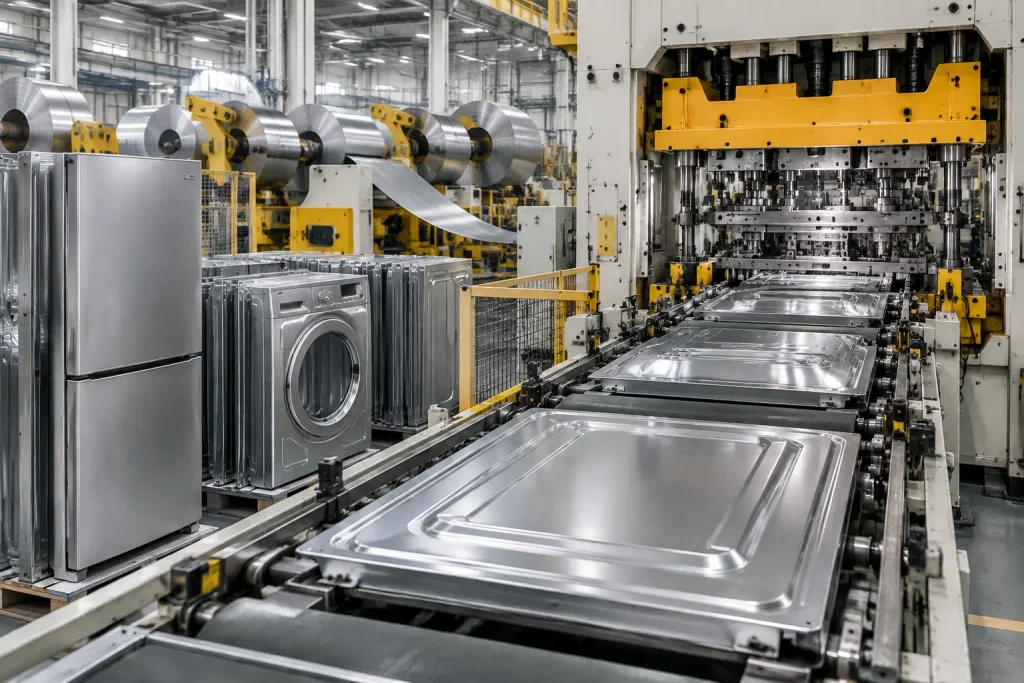
What Makes Home Appliance Stamping Different
Appliance stamping has three defining characteristics. In other words, home appliance stamping is not the same as automotive or general stamping.
Large Surface Area Panels
AC outdoor unit housings, refrigerator door panels, washer drums — these are not small parts. They demand wide strip material (400–800mm is common), which means the feeding system must handle wide coils with uniform roller pressure across the full width. Any uneven clamping or leveling shows up immediately as waviness across the panel surface.
Thin Gauge Materials
Appliance panels are typically 0.5–1.5mm cold-rolled steel, galvanized steel, or pre-coated steel. Thin material is more sensitive to leveling quality — it buckles and wrinkles easily if the leveler gap isn’t set correctly.
High-Volume, Moderate Precision
Unlike automotive stamping where ±0.05mm tolerances are common, home appliance stamping parts typically work within ±0.2 to ±0.5mm. However, the bigger challenge is throughput: these lines run at 30–50 SPM for thousands of cycles per shift, and the feeding equipment must keep up without fatigue or drift.
Typical Appliance Parts and Their Feeding Requirements
| Part | Material | Width Range | Thickness | Key Requirement |
|---|---|---|---|---|
| AC outdoor unit housing | Galvanized steel | 500–800mm | 0.6–1.0mm | Wide strip, uniform leveling |
| Refrigerator door panel | Pre-coated steel | 500–700mm | 0.5–0.8mm | Gentle handling to protect coating |
| Microwave cavity body | Cold-rolled steel | 400–600mm | 0.6–1.2mm | Precision folding, consistent feed |
| Washing machine drum | Stainless steel | 300–500mm | 0.5–0.8mm | Non-marring roller surface |
| Range hood body | Stainless / CR steel | 300–600mm | 0.5–1.0mm | High polish surface, scratch-free handling |
The Ideal Equipment Combination for Home Appliance Stamping
For most appliance stamping applications, a 3-in-1 compact coil feed line is the optimal configuration. Here’s why:
1. Space Efficiency
Appliance factories are often large, multi-line operations. Consequently, floor space is a real cost. A 3-in-1 unit (decoiler + leveler + feeder in one frame) saves roughly 40% floor space compared to three separate machines. Across 10 press lines, that’s substantial.
Jingcui’s NLF1-600 or NLF1-800 covers the 400–800mm width range that covers most appliance panel stamping.
2. Fast Coil Changeovers
Appliance manufacturers frequently switch between different panel SKUs — black vs white, different models, different sizes. Each change means a coil swap. In fact, a hydraulic expansion decoiler with quick-release mandrel reduces changeover time from 15+ minutes to under 5.
3. Consistent Surface Quality
Pre-coated and galvanized steel panels are finished goods — scratches show. NC servo feeders with polished, hard chrome-plated rollers minimize surface marking. The pilot release function backs off the rollers at exactly the right moment to prevent roller marks on the strip during press dwell.
Throughput Optimization for Home Appliance Stamping
Once the equipment is in place, these operational practices maximize output. Above all, disciplined coordination between operators and feeders is what separates a smooth line from a bottlenecked one:
Staged Coil Preparation
Have the next coil pre-staged on a coil car or forklift-ready at the decoiler station before the current coil runs out. Every minute saved on changeover is a minute of press production.
Recipe-Based Setup
NC servo feeders with job memory let you store feed length, speed, and stage settings for each part number. When you switch from an AC panel to a refrigerator panel, you load the recipe — not manually re-enter numbers. Jingcui feeders support 20 groups of feed settings per job.
Preventive Maintenance Scheduling
Thin-gauge appliance material amplifies any leveler roll imperfection. Schedule weekly roll cleaning and monthly parallelism checks. A slight roll misalignment that’s acceptable on 3mm plate will cause visible defects on 0.6mm galvanized sheet.
Home Appliance Stamping Trends Affecting Equipment Choice
Trend 1: Thinner, Higher-Strength Steel
To reduce material cost and weight, appliance OEMs are spec’ing thinner but higher-strength steels. As a result, levelers need more rolls to achieve flatness on stronger material, and feeders need more precise control to handle thin strip without buckling.
Trend 2: Pre-Coated and Laminated Materials
More panels arrive at the press with decorative coatings already applied. The feeding system must handle these materials without scratching or delaminating. Specifying chrome-plated rollers and adjusting clamping pressure for coated material is no longer optional — it’s standard.
Trend 3: Shorter Model Cycles
Appliance models refresh more frequently than ever. The feeding line needs to accommodate a wider variety of part sizes without major reconfiguration. Choosing equipment with generous width and thickness margins future-proofs your line.
Jingcui’s Appliance Industry Solutions
At Jingcui Automation, we’ve been supplying stamping feeding equipment to appliance manufacturers for 22 years from our factory in Shunde, Foshan — a region that supplies equipment to many of China’s largest appliance brands.
Our recommended appliance stamping line configuration:
- NLF1 series 3-in-1 compact feeder (400–800mm width) as the core feeding unit
- Hydraulic decoiler expansion for fast coil changes
- 11-roll precision leveling cassette (6 upper / 5 lower) for thin-gauge panel flatness
- NC servo feeder with recipe memory for quick SKU changeovers
- Optional handling robot for finished part stacking — see our handling robots
Every line is factory-tested and verified before shipment.
Frequently Asked Questions
What equipment do I need for home appliance stamping?
For most appliance panels, a 3-in-1 compact coil feed line (decoiler + leveler + feeder combined) is the ideal core unit for home appliance stamping. Add a hydraulic decoiler expansion for fast coil changes and an optional handling robot for part stacking.
How wide is appliance stamping material?
Appliance panels commonly run 400–800mm wide. This is why the feeding system needs uniform roller pressure across the full width — any uneven leveling shows up as surface waviness.
What thickness is appliance stamping material?
Typically 0.5–1.5mm cold-rolled, galvanized, or pre-coated steel. Thin gauge is sensitive to leveler gap settings, so precision leveling and gentle surface handling matter.
Is a 3-in-1 feeder right for appliance stamping?
Yes, for most cases. It saves about 40% floor space, speeds up coil changeovers, and protects surface quality of coated panels. Learn more in our 3-in-1 decoiler straightener feeder guide.
How do I protect coated panels from scratches?
Use chrome-plated rollers and a pilot-release function that backs off rollers during press dwell. This is standard for pre-coated and galvanized appliance panels. For leveling details, see our coil leveler guide.
Running appliance stamping lines? Let’s optimize your feeding system.
Contact Jingcui Automation with your material specs, part dimensions, and production targets. We’ll recommend a verified configuration that fits your press room — and your budget.
📞 WhatsApp: +86 133 6064 4989 | 🌐 jingcuiautomation.com



Leave a Reply