
جدول المحتويات
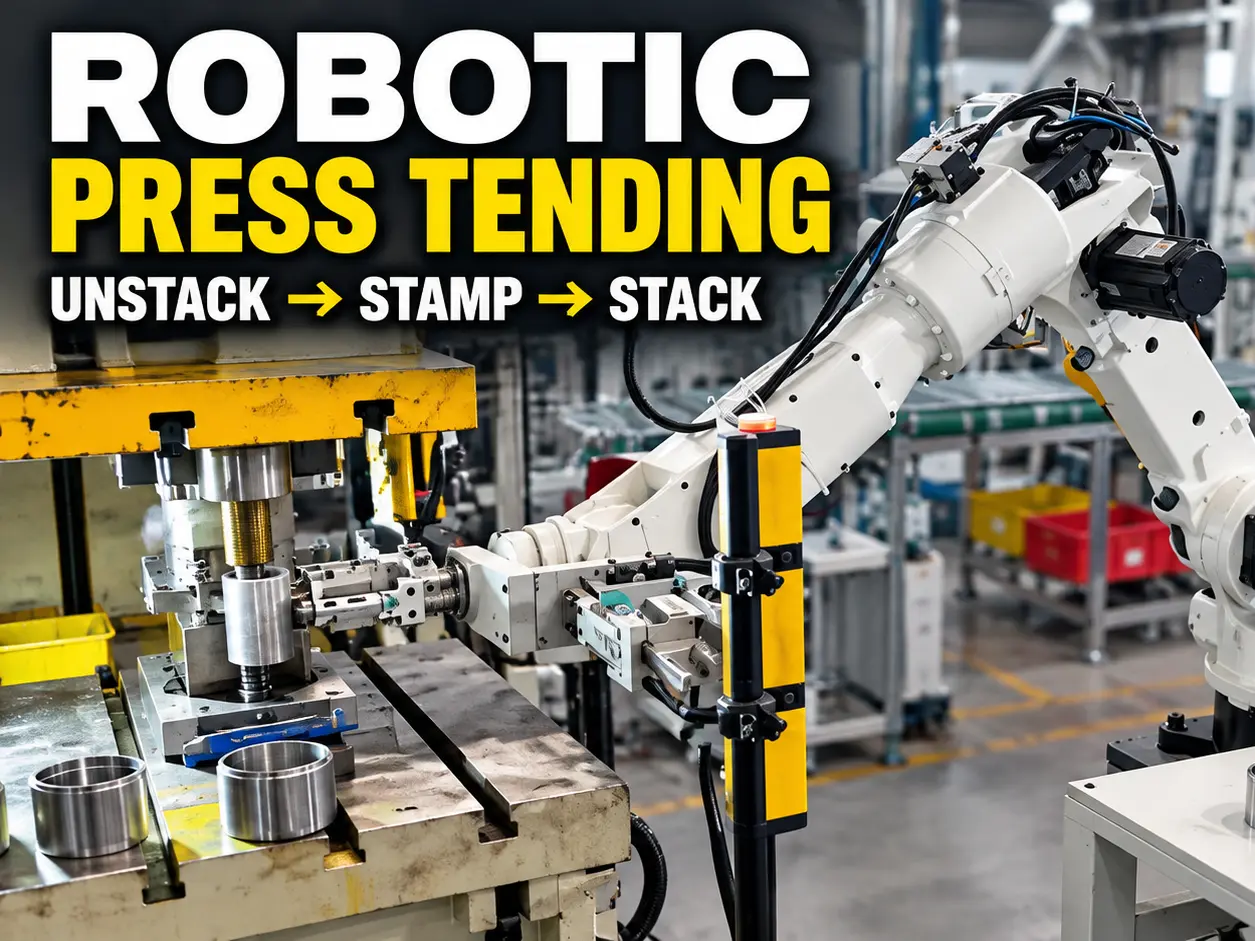
A robotic press tending cell is a six-axis arm that runs the whole load-unload loop on a stamping line — un-stacking raw blanks, placing them into the die, catching formed parts and re-stacking them on the pallet — in one continuous cycle, at press pace, without a hand ever reaching into the danger zone. It takes what used to be three separate manual jobs and turns them into a single hands-off operation. For the feeding side of the same line, see our stamping automation line guide أو industrial robots on Wikipedia.
What a robotic press tending cell actually does
يقوم جهاز robotic press tending cell is more than a robot bolted next to a press. It is a coordinated workstation that performs three moves in a closed loop:
- Un-stack — the arm lifts raw blanks (housings, panels, covers) from an input stack one at a time
- Stamp — it places each blank into the die with repeatable precision
- Stack — it catches the finished part and palletizes it neatly for the next operation
Because all three happen in the same cycle, a single six-axis arm replaces the operator on both sides of the press — the side that loads and the side that unloads. That is the difference between a robot doing one lift and a cell doing the whole job.
Why one cell beats three manual stations
The argument for a robotic press tending cell comes down to consistency, safety and pace — in that order. For example, consider a generator-housing line where the operator previously reached into the press every few seconds:
- Constant cycle — the arm repeats the same motion every cycle, so line speed no longer depends on operator fatigue or shift change
- No reach-in risk — most stamping injuries happen when a hand is in the wrong place at the wrong time, and the cell removes that exposure entirely
- Fewer marks — no hand contact means cleaner, oil-free finished parts
- Continuous pace — the press keeps cycling through breaks and shift changes instead of stalling
How to spec a press tending cell
Three numbers decide whether a robotic press tending cell fits your part and your press:
- Reach — the working radius must cover the die area, the input stack and the output pallet (1650 mm serves most medium press-tending layouts)
- Payload — the wrist load must exceed your heaviest part plus the gripper (10 kg is the common mid-range rating)
- قابلية التكرار — placement accuracy determines whether every blank lands in the die the same way (±0.05 mm is typical for this class)
Also confirm the gripper strategy — vacuum, magnetic or mechanical — because a thin or coated part may need a different grip than a heavy housing. And check cycle-time targets, since the cell has to keep up with, not throttle, the press speed.
Where the cell sits in a full line
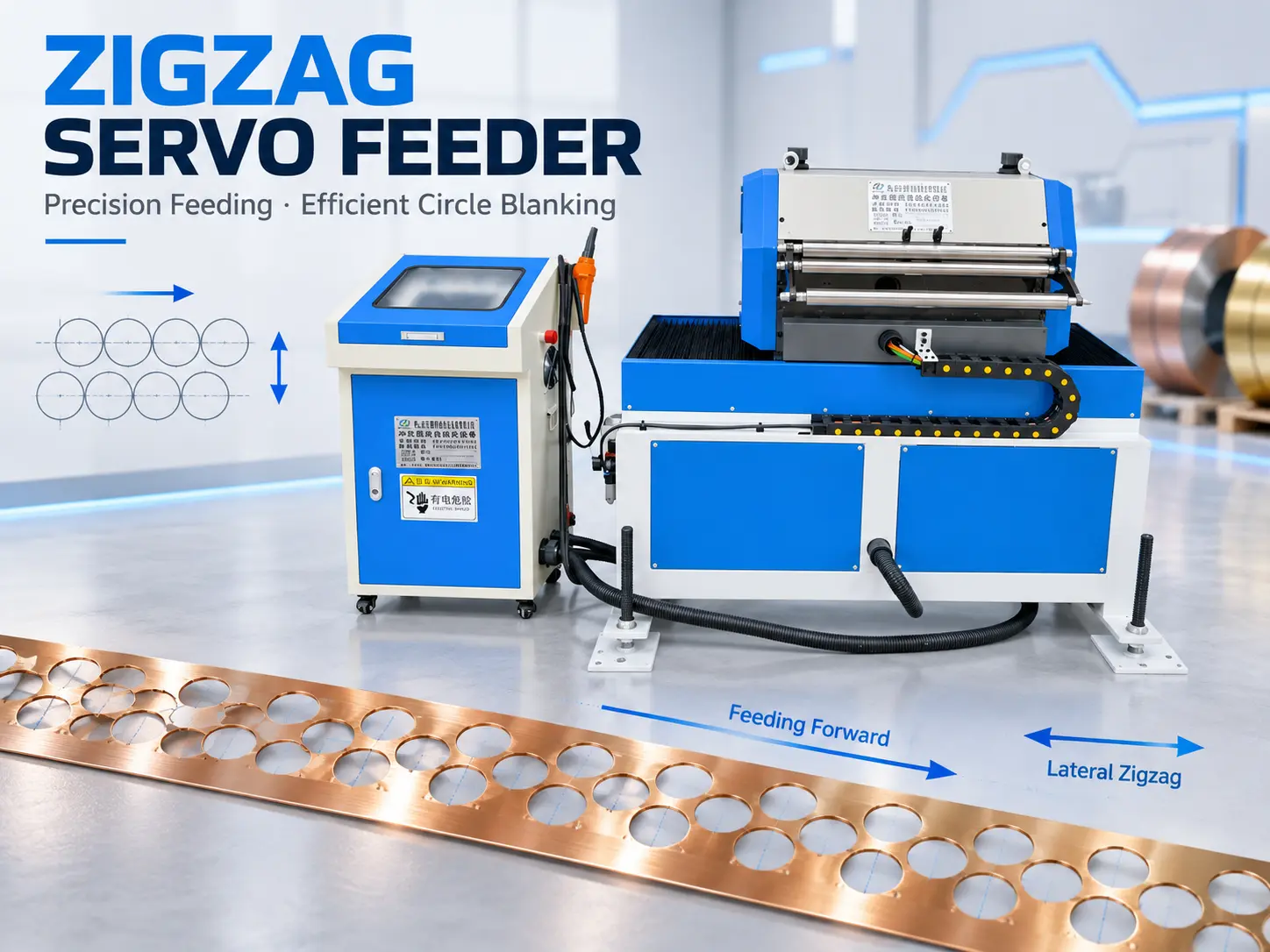
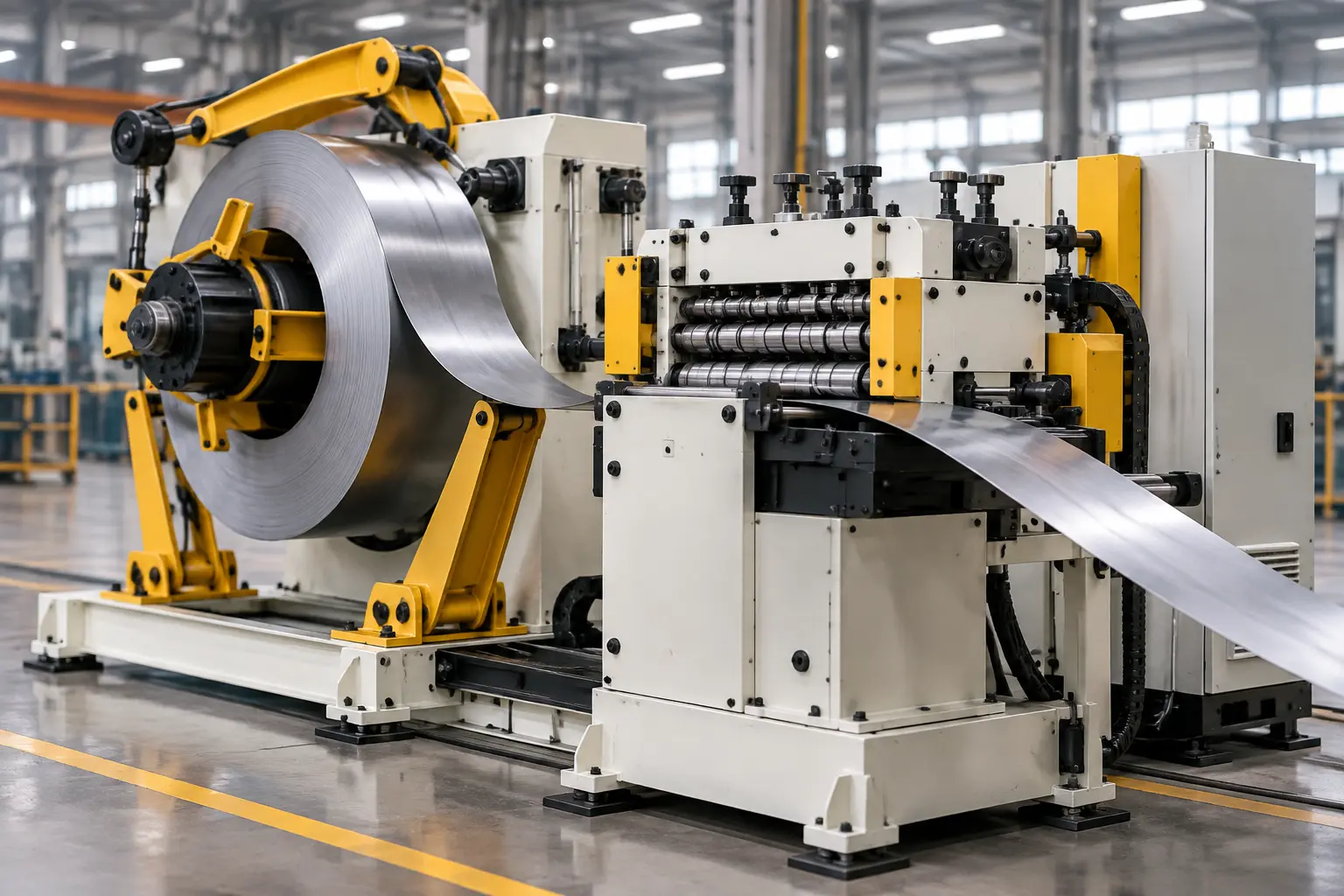
يقوم جهاز robotic press tending cell usually slots between the feeder and downstream handling. The decoiler pays off coil, the straightener and جهاز التغذية المؤازر NC position it, the press forms it, and the cell handles the load-unload and palletizing. For heavier plate feeding upstream, see our thick plate straightening guide.
The practical starting point is your bottleneck: the station where manual handling slows the line, or where reach-in risk is highest. Automate that one first, run it, then expand the cell to the next press.
Is a robotic press tending cell right for your volume?
يقوم جهاز robotic press tending cell pays back fastest when:
- Parts are high-volume with short cycles
- Parts are too heavy, hot or sharp to handle safely by hand
- The line runs multiple shifts, so fatigue and labour cost compound
For low-volume, long-cycle work the payback is slower — and it is fair to hold off until the volume justifies the automation. Likewise, a very small or irregular part family may need more custom gripper engineering before a cell makes sense.
الأسئلة الشائعة
يقوم جهاز robotic press tending cell is a six-axis robot workstation that automatically un-stacks blanks, loads them into the press, and stacks finished parts — the full load-unload loop in one cycle.
Six axes give the reach, twist and angle a cell needs to un-stack, place and re-stack around a die; fewer axes suit simpler straight-line pick-and-place.
Match reach to your die area, input stack and output pallet, and payload to your heaviest part plus gripper — 1650 mm reach and 10 kg load cover many medium press-tending cells.
Yes, with enough reach and the right layout. Start with the bottleneck press, prove the cycle, then extend the cell to adjacent stations.
Yes — it removes the operator’s hand from the load and unload zone, which is where most stamping injuries occur.
Planning a robotic press tending cell?
Contact Jingcui Automation. Tell us your part weight, cycle time and press layout — we’ll help you spec the right reach, payload and gripper, and design the un-stack–stamp–stack loop for your line.
واتساب: +86 133 6064 4989

 English
 Русский
 ไทย
 Tiếng Việt
 Español de México
 العربية
اترك تعليقاً