
Table of Content
- What a Custom Decoiler Straightener Can Be Built Around
- The 8 Numbers That Define Your Custom Decoiler Straightener
- The Thick-Material Warning You Shouldn't Skip
- Non-Standard I.D.? Here's the Clean Fix
- Voltage and Power: Match It Before You Buy
- How the Custom Process Works at Jingcui
- Frequently Asked Questions
- Have non-standard coil specs? Let's spec your custom decoiler straightener.
A custom decoiler straightener is the answer to one of the most common frustrations in stamping: your coil doesn’t match the catalog. Maybe your width is 350mm when every stock machine is built for 300mm or 400mm. Maybe your coil I.D. follows a regional standard the factory didn’t anticipate. Or your plant runs 440V three-phase when the default is 380V.
The good news: a decoiler straightener is not a fixed-configuration commodity. It can usually be engineered around your non-standard dimensions and electrical supply. The catch is that it should be engineered, not just “modified.” Here’s what you can reasonably ask for, and how to ask so the supplier can’t undersize the machine.
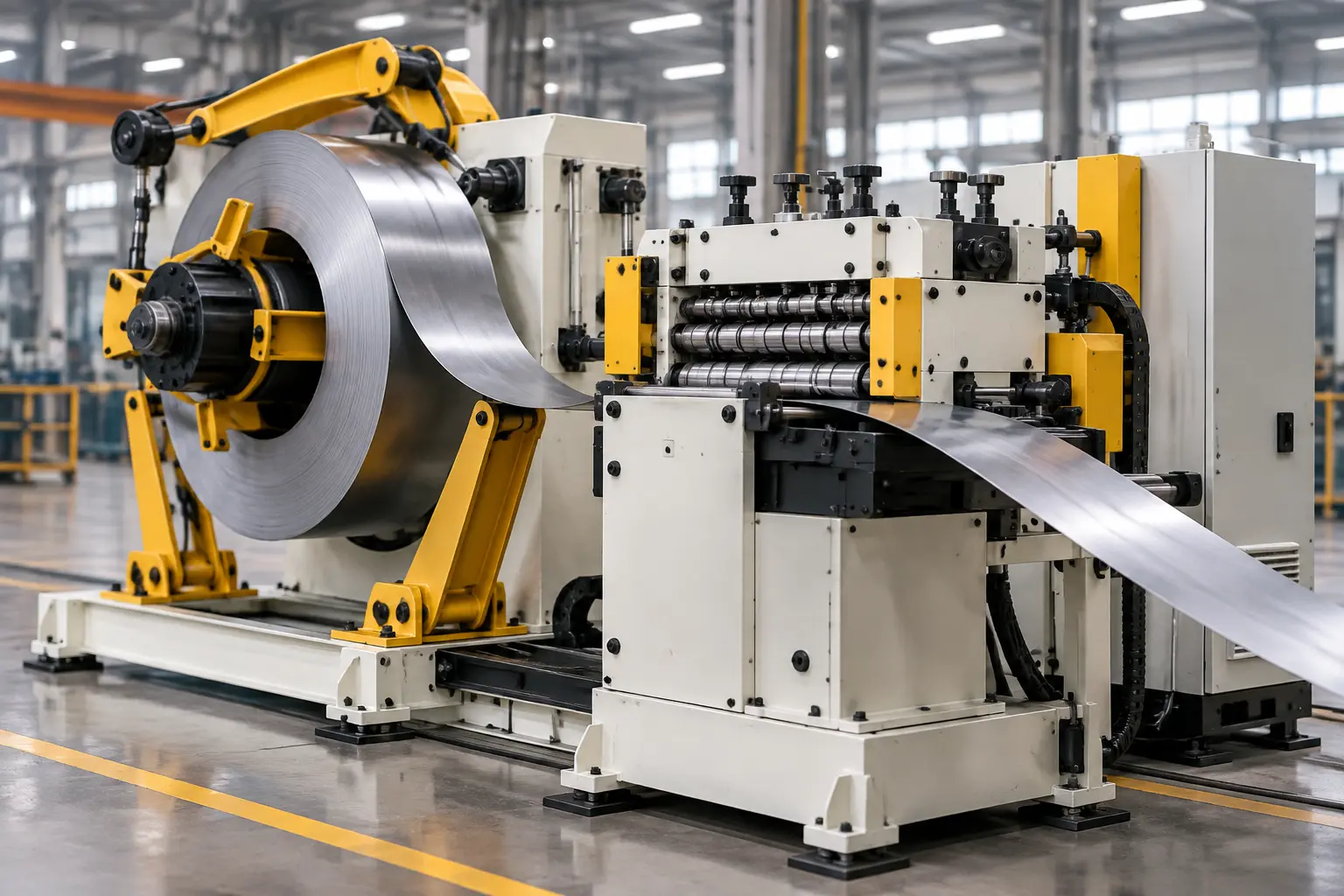
What a Custom Decoiler Straightener Can Be Built Around
Most manufacturers position “custom” as an add-on. At Jingcui, customization is the default. Here are the six dimensions you can specify on a custom decoiler straightener:
- Coil width — non-standard widths (e.g. 350, 450, 550, 750mm) or extended widths up to large-format strip.
- Coil I.D. / O.D. — a different mandrel or expansion range to bridge regional standards (European vs. Asian I.D.), or hydraulic expansion for heavy coils.
- Voltage — 220V / 380V / 415V / 440V, three-phase, 50/60Hz, matched to your local grid.
- Expansion type — manual, hydraulic, or clamping-style for unusually small I.D.s.
- Control system — VFD, PLC/HMI, sensors, and automatic loop control.
- Press connection — coordinated feeding and control with your existing press or servo feeder.
The 8 Numbers That Define Your Custom Decoiler Straightener
Instead of a long back-and-forth email, send these eight numbers and we can return a specification for your custom decoiler straightener that can’t be undersized:
- Strip width (min–max)
- Thickness (min–max)
- Steel grade / yield strength
- Coil weight (kg)
- Coil I.D. (mm)
- Coil O.D. (mm)
- Line speed (m/min)
- Factory power (V / phase / Hz)
Give us these, and we’ll specify the mandrel size, roller diameter and count, motor power, coil capacity, hydraulic vs. manual expansion, and the key items to lock into your RFQ so the machine is built to your real line — not a wish.
The Thick-Material Warning You Shouldn’t Skip
A frequent mistake is treating “custom” as “take a standard 0.4–3.2mm machine and stretch the spec.” If you’re running 4–6mm coil steel, you don’t modify a light-duty unit — you move to a reinforced thick-plate 2-in-1 class from the start. The allowable width at 6mm depends heavily on thickness, yield strength, coil weight, and required flatness, and the roll system has to be substantially more robust to handle it.
When you request a custom build, ask the manufacturer to confirm capacity at your actual combined thickness, width, and steel grade — not just a headline maximum. (We cover thick-plate selection in detail in our thick-plate 2-in-1 guide.)
Non-Standard I.D.? Here’s the Clean Fix
Unusually small or off-standard coil inner diameters are a common sticking point for a custom decoiler straightener. The standard answer is an expanding mandrel, but when the I.D. is simply too small for a conventional mandrel, a clamping-style design can be a better fit than forcing an expansion mechanism into a space it wasn’t built for.
Likewise, if you run coils from both European and Asian suppliers with different I.D. standards, a mandrel with adapter segments can bridge the gap without needing a second machine. Tell us the I.D. range you actually run, and we’ll spec the holding arrangement around it.
Voltage and Power: Match It Before You Buy
Electrical requirements should be confirmed for the specific machine, never assumed. Common industrial supplies include 220V and 380V three-phase at 50Hz (much of Asia and Europe) and 415V/440V at 60Hz (parts of the Americas and the Middle East). The motor, control panel, and VFD must be specified to your local grid — retrofitting voltage after delivery is messy and can void warranty coverage. For background on the stamping process itself, see Wikipedia’s stamping overview.
How the Custom Process Works at Jingcui
Our custom decoiler straightener process is straightforward:
- You share the 8 numbers (above) plus any part drawings or die layout.
- We confirm the configuration — mandrel, roller count/diameter, motor, expansion, voltage.
- We return a written spec sheet so every parameter is locked before production.
- Factory testing — we run your actual material (or equivalent) against the spec before shipment.
- Overseas installation support — our engineers commission the machine on your line.
Because we design and manufacture in-house at our Shunde, Foshan factory, non-standard requests don’t get quoted-and-forgotten — they get engineered.
Frequently Asked Questions
Yes. Width is the most common customization — you can specify non-standard widths (350, 450, 550, 750mm, etc.) or extended widths for large-format strip, rather than being limited to the catalog.
We can engineer a different mandrel or expansion range, use adapter segments to bridge regional I.D. standards, or — for unusually small I.D.s — a clamping-style design instead of a conventional expanding mandrel.
Yes. We build to 220V / 380V / 415V / 440V, three-phase, 50/60Hz, with the motor, control panel, and VFD specified to your plant’s actual supply. Always confirm voltage before ordering rather than assuming a default.
Because we manufacture in-house, a non-standard width or voltage typically adds little to cost or lead time compared to a stock configuration. What matters more is getting the spec right up front — an undersized machine is far more expensive than proper customization.
Lock in these specifics: strip width and thickness range, steel grade/yield strength, coil weight, coil I.D. and O.D., line speed, and factory voltage/phase/Hz. Then require a written spec sheet confirming every parameter before production.
Have non-standard coil specs? Let’s spec your custom decoiler straightener.
Send Jingcui Automation your 8 numbers — width, thickness, grade, coil weight, I.D., O.D., line speed, and voltage — and we’ll return a custom decoiler straightener specification built to your exact line.
📞 WhatsApp: +86 133 6064 4989


 English
 Русский
 ไทย
 Tiếng Việt
 Español de México
 العربية
Leave a Reply